
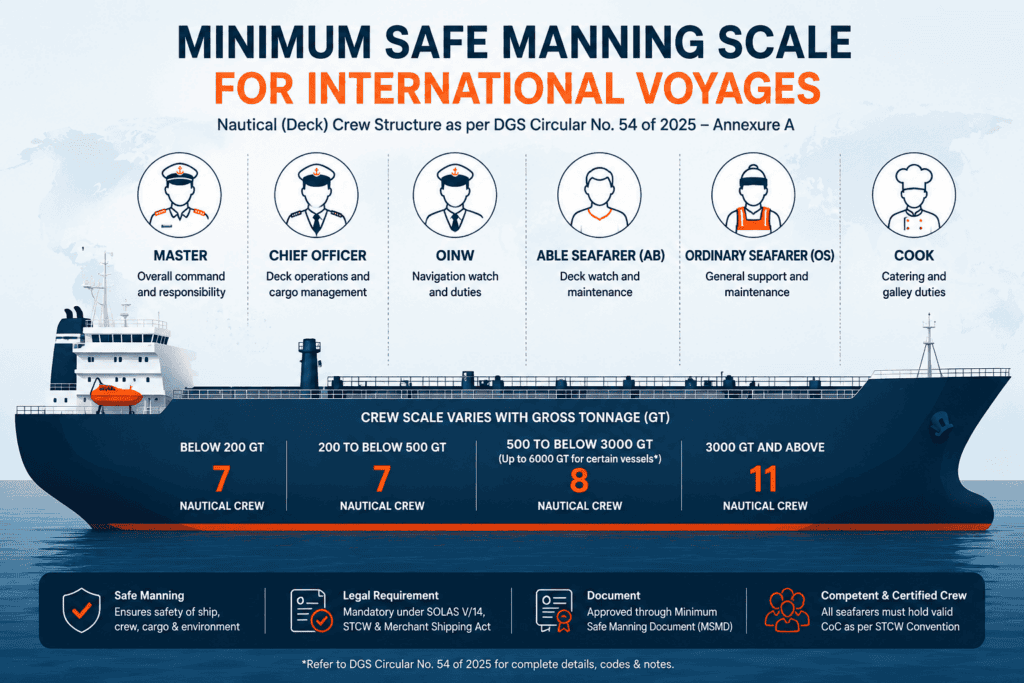
The minimum safe manning scale for international voyages sets the nautical crew every Indian ship must carry under DGMA Circular No. 54 of 2025, Annexure A. A vessel under 200 GT needs a master, one deck officer, and four ratings. A ship above 3000 GT needs up to 11 nautical crew, plus separate engine room manning.
Every Indian flag vessel trading internationally needs an approved crew list before it clears port, and that number is not a guess. It comes from a fixed scale tied to the Merchant Shipping Act, and getting it wrong can hold up a ship’s Minimum Safe Manning Document. This guide breaks down Annexure A rank by rank so ship managers, cadets, and crewing teams know exactly what a compliant deck crew looks like.
Why Does DGMA Circular No. 54 of 2025 Matter for International Voyages?
For years, India’s manning rules sat scattered across circulars going back to 2007. Each new order added a category or tweaked a number, and shipowners had to track a dozen documents just to confirm one crew list. DGMA Circular No. 54 of 2025, issued on 8 December 2025 and published on the DGMA circular portal, folds all of that into a single reference.
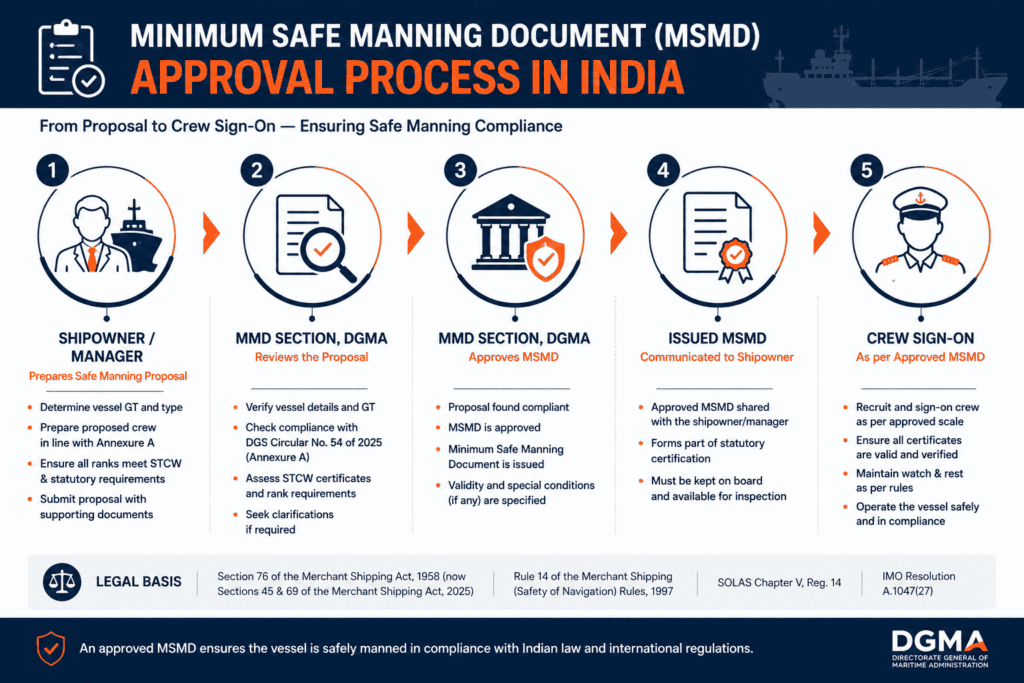
The circular rests on three legal pillars. IMO Resolution A.1047(27) sets the global framework for deciding crew size. SOLAS Chapter V, Regulation 14, makes safe manning mandatory for every flag administration. Section 76 of the Merchant Shipping Act, 1958, now Sections 45 and 69 under the Merchant Shipping Act, 2025, gives the rule its force in Indian law. Rule 14 of the Merchant Shipping (Safety of Navigation) Rules, 1997 is what actually requires every ship to hold a Safe Manning Certificate, commonly called the Minimum Safe Manning Document (MSMD).
One naming note is worth flagging here. The regulator behind this circular, the Directorate General of Shipping (DGMA), was renamed the Directorate General of Maritime Administration (DGMA) in June 2026. The circular itself still carries its original DGMA numbering.
What Is the Minimum Safe Manning Scale for International Voyages? (Annexure A)
Annexure A covers self-propelled cargo and non-passenger vessels registered under the Merchant Shipping Act, with crew numbers scaling to a ship’s Gross Tonnage (GT). Passenger ships, Ro-Ro, and Ro-Pax vessels follow a separate scale under Annexure G, and vessels below 15 GT are notified separately. The table below is the nautical, or deck, scale only. Engine room manning is prescribed elsewhere.
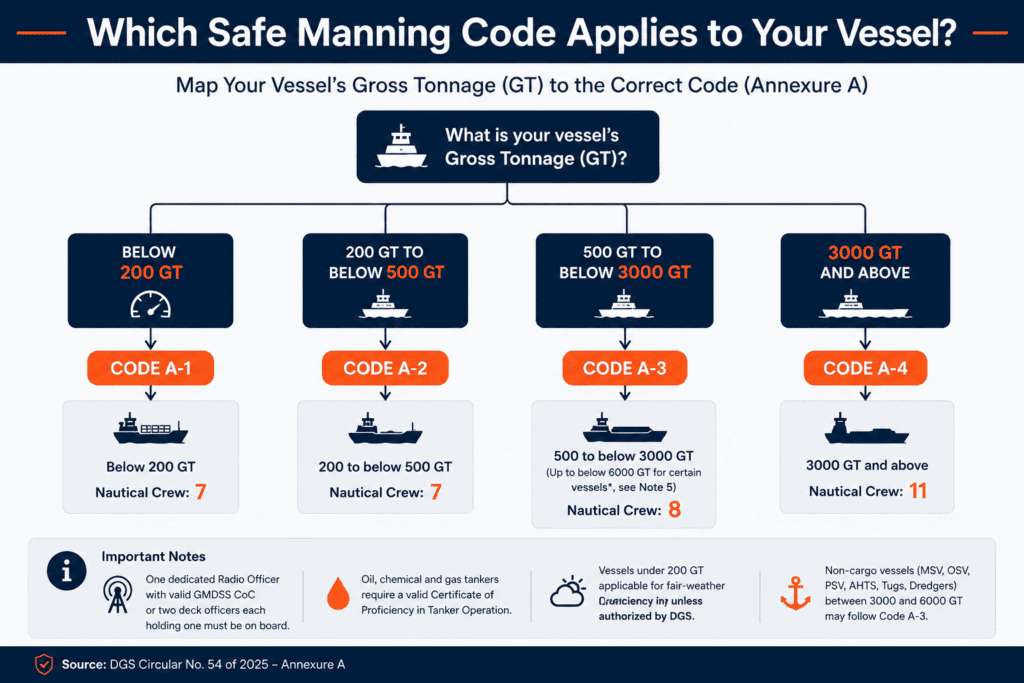
| Code | GT of Vessel | Master | Chief Officer | OINW | AB | OS | Cook |
| A-1 | Below 200 | Master (FG): 1 | 2nd Mate (FG): 1 | Not required | Able Seafarer Deck II/5: 2 | Rating, Basic STCW safety training: 1 | Basic STCW safety training + CoC as Cook: 1 |
| A-2 | 200 to below 500 | Master (FG): 1 | Mate (FG): 1 | Not required | Able Seafarer Deck II/5: 2 | Rating, Basic STCW safety training: 1 | Basic STCW safety training + CoC as Cook: 1 |
| A-3 | 500 to below 3000 (up to below 6000 for MSV/OSV/PSV/AHTS/Tugs/SPS/Dredgers, see Note 5) | Master (FG): 1 | Mate (FG): 1 | 2nd Mate FG: 1 | Able Seafarer Deck II/5: 2 | Rating, Basic STCW safety training: 1 | Basic STCW safety training + CoC as Cook: 1 |
| A-4 | 3000 and above | Master (FG): 1 | Mate (FG): 1 | 2nd Mate FG: 2 | Able Seafarer Deck II/5: 3 | Rating, Basic STCW safety training: 3 | Basic STCW safety training + CoC as Cook: 1 |
Four rules apply across every code in this table. One dedicated Radio Officer with a valid GMDSS CoC, or two deck officers who each hold one, must be on board. Oil, chemical, and gas tankers need a valid Certificate of Proficiency in Tanker Operation. Vessels under 200 GT can only rely on this scale for fair-weather operation, unless the Directorate specifically authorises otherwise. Non-cargo vessels such as MSVs, OSVs, PSVs, AHTS, tugs, and dredgers between 3000 and 6000 GT may follow the lighter Code A-3 scale instead of A-4.
What is the change in crew numbers between code A-1 and code A-4?
The scale grows with tonnage in a predictable pattern. Vessels under 500 GT, Codes A-1 and A-2, sail with just a master and one deck officer, since a separate Officer in Charge of a Navigational Watch (OINW) is not required at this size. Once a vessel reaches 500 GT, a third watchkeeping officer, a 2nd Mate holding a Foreign-Going certificate, joins the bridge as OINW. Cross 3000 GT and that OINW count doubles to two, while AB and OS ratings each rise to three.
A 450 GT general cargo ship, Code A-2, can trade internationally with just 6 people under Annexure A: Master, Mate, 2 AB, 1 OS, and 1 Cook. A bulk carrier above 3000 GT, Code A-4, needs 11, before anyone in the engine room is even counted.
What Extra Certificates Does the International Voyage Crew Need?
Numbers alone do not make a crew compliant. Every rank under Annexure A carries a matching Foreign-Going (FG) or equivalent qualification, from Master (FG) down to Able Seafarer Deck under STCW Regulation II/5. Ratings need basic STCW safety training, and the ship’s cook needs STCW safety training plus a Certificate of Proficiency as Cook where applicable.
Officers working toward these ranks usually start through structured pathways such as the Second Mate FG course, while deck ratings often begin with a GP Rating course before moving into AB and OS positions.
How Is the Minimum Safe Manning Document (MSMD) Issued?
The responsibility to apply sits with the shipowner or manager, not the crew. The company submits a safe manning proposal, along with a self-assessment checklist, online to the concerned Mercantile Marine Department (MMD). The MMD checks this proposal against the Annexure A scale and any extra crew the company proposes for trading patterns, maintenance, or rest-hour compliance.
New ship managers often miss one detail: the numbers in Annexure A are a floor, not a ceiling. The circular is explicit that owners must add personnel wherever operational needs, trade practice, or seafarer rest periods demand it. Once the MSMD is approved, the ship must be crewed strictly to that document, and registered RPSL manning agencies build their placement plans around it.
Can a Shipping Company Get a Dispensation From the Manning Scale?
Only in narrow, exceptional cases. If a crew member falls ill, gets injured, or becomes suddenly unavailable, the company can request a temporary dispensation, though the directorate treats these as rare exceptions, not a routine workaround.
The process runs in two stages. First, the company applies to the Nautical Wing with full details of the case, including the applicable Maritime Union of India wage scale for the rank concerned. Once approval in principle is granted, the company must remit the maximum basic wage for that rank to the Directorate before the dispensation takes effect. This wage-remittance step exists for a specific reason: it removes any financial incentive to sail short-handed and protects job opportunities for qualified officers.
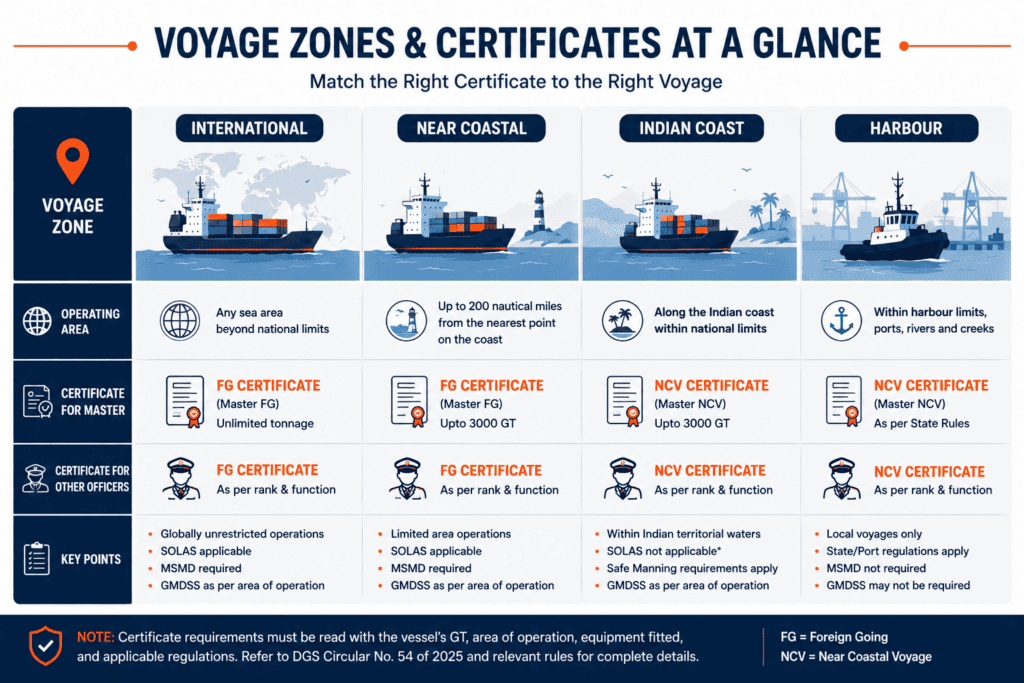
How Does the International Scale Compare With Near Coastal and Indian Coast Scales?
Annexure A is one of four main nautical scales in the circular, and the real difference between them comes down to certification level more than head count.
| Scale | Annexure | Voyage Type | Smallest Vessel Master Qualification | Officer Certificate Standard |
| International voyages | A | Beyond near-coastal limits, worldwide trade | Master (FG) | Foreign-Going (FG) throughout |
| Near-coastal voyages | B | Defined near coastal zone | Master NCV (500 GT) or Mate NCV | NCV, stepping up to FG above 6000 GT |
| Indian coast, incl. A&N and Lakshadweep | C | Indian coastline and island territories | Master NCV (500 GT) or Mate NCV | NCV, stepping up to FG above 6000 GT |
| Harbour operations | D | Smooth or partially smooth waters near a port | 1st Class IV Master | Harbour-specific IV Class or NCV |
Officers on near coastal and Indian coast trades can often hold NCV (Near Coastal Voyage) certificates, which cost less and train faster than Foreign-Going certificates. Once a ship crosses into international waters, every certificate on the bridge has to step up to FG standard.
What Happens If a Ship Sails Below Its Approved Manning Scale?
The circular is direct on this point. Every ship must be manned strictly in accordance with the scale specified in its approved MSMD (Minimum Safe Manning Document). Sailing with fewer or less qualified crew than the certificate allows is a compliance failure that Flag State and Port State inspectors check during surveys, and it defeats the entire purpose of the scale: preventing fatigue and keeping enough qualified hands on deck and on the bridge at all times.
FAQs
What is the minimum safe manning scale for international voyages?
It is the fixed number and rank of nautical crew, from Master to Cook, that every Indian ship must carry on international voyages, set out in Annexure A of DGMA Circular No. 54 of 2025.
Which circular governs safe manning for Indian ships today?
DGMA Circular No. 54 of 2025, issued on 8 December 2025 by the Directorate General of Shipping (now DGMA), consolidates all earlier manning circulars into one document.
What is a Minimum Safe Manning Document (MSMD)?
The MSMD, also called the Safe Manning Certificate, is the official document confirming exactly how many crew, and at what rank, a specific ship must carry.
How many crew does a vessel under 200 GT need under Code A-1?
Code A-1 requires a Master (FG), a 2nd Mate (FG), 2 AB ratings, 1 OS, and 1 Cook, a total of 6 nautical crew, plus a GMDSS-qualified officer.
Does every ship on an international voyage need a dedicated Radio Officer?
Not necessarily. The rule is satisfied by either one dedicated Radio Officer with a GMDSS CoC or two deck officers who each hold a GMDSS CoC.
What qualification must the Master hold under Annexure A?
The Master must hold a Master (FG), or Foreign-Going, Certificate of Competency at every tonnage level under Annexure A, unlike coastal scales that allow NCV certificates.
Can a shipowner add crew beyond the minimum safe manning scale?
Yes, and the circular expects it. Annexure A sets the floor, and owners must add crew for trading needs and maintenance and to guarantee adequate rest hours.
What happens if a ship sails with fewer crew than its MSMD allows?
It breaches the approved Minimum Safe Manning Document. Port State and Flag State inspectors check MSMD compliance during surveys, and shortfalls put the vessel’s certification at risk.
When can a company apply for a manning dispensation?
Only for genuine exigencies such as a crew member’s sudden illness, injury, or unavailability. The company must apply to the Nautical Wing and remit the applicable wage before approval.
Who decides the final manning scale for a specific ship?
The Mercantile Marine Department (MMD) decides, based on the company’s proposal, the Annexure A minimum, and operational factors such as trading patterns and rest-hour rules.