
Minimum safe manning requirements for Indian coast vessels come from Annexure C of DGMA Circular No. 54 of 2025, and they cover ships trading along India’s coastline, including the Andaman & Nicobar Islands and Lakshadweep. A vessel under 200 GT needs just 4 nautical crew. A vessel at 6000 GT or above needs 8, with foreign-going certificates required at master and mate levels.
If you manage an Indian flag vessel trading on the Indian coast, or you crew ships serving the island territories, this scale decides what goes on your Minimum Safe Manning Document. This guide is part of our series on minimum safe manning requirements for Indian flag vessels, which maps the whole circular. It also connects closely with our guides to Annexure A for international voyages and Annexure B for near coastal voyages, the two scales most often confused with this one.
Why Does DGMA Circular No. 54 of 2025 Cover Vessels on the Indian Coast Separately?
Vessels trading along India’s own coastline, rather than out to sea internationally, face a different mix of risks and a different certification pool. DGMA Circular No. 54 of 2025 recognises that by giving Indian coast vessels, including those serving the Andaman & Nicobar Islands and Lakshadweep, their own dedicated annexure. Our pillar guide to the circular explains where Annexure C sits among the other eight scales.
The legal foundation is the same one behind every annexure in the circular. IMO Resolution A.1047(27) sets the global framework; SOLAS Chapter V Regulation 14 makes a manning document mandatory; and India applies both through the Merchant Shipping Act. What changes here is the practical detail. Annexure C accepts NCV certification for longer than most other scales, and it reflects rest-hour thinking similar to what our guide to maritime conventions for Indian seafarers covers for STCW watchkeeping rules.
What Is the minimum safe manning requirements for Indian coast vessels (Annexure C)
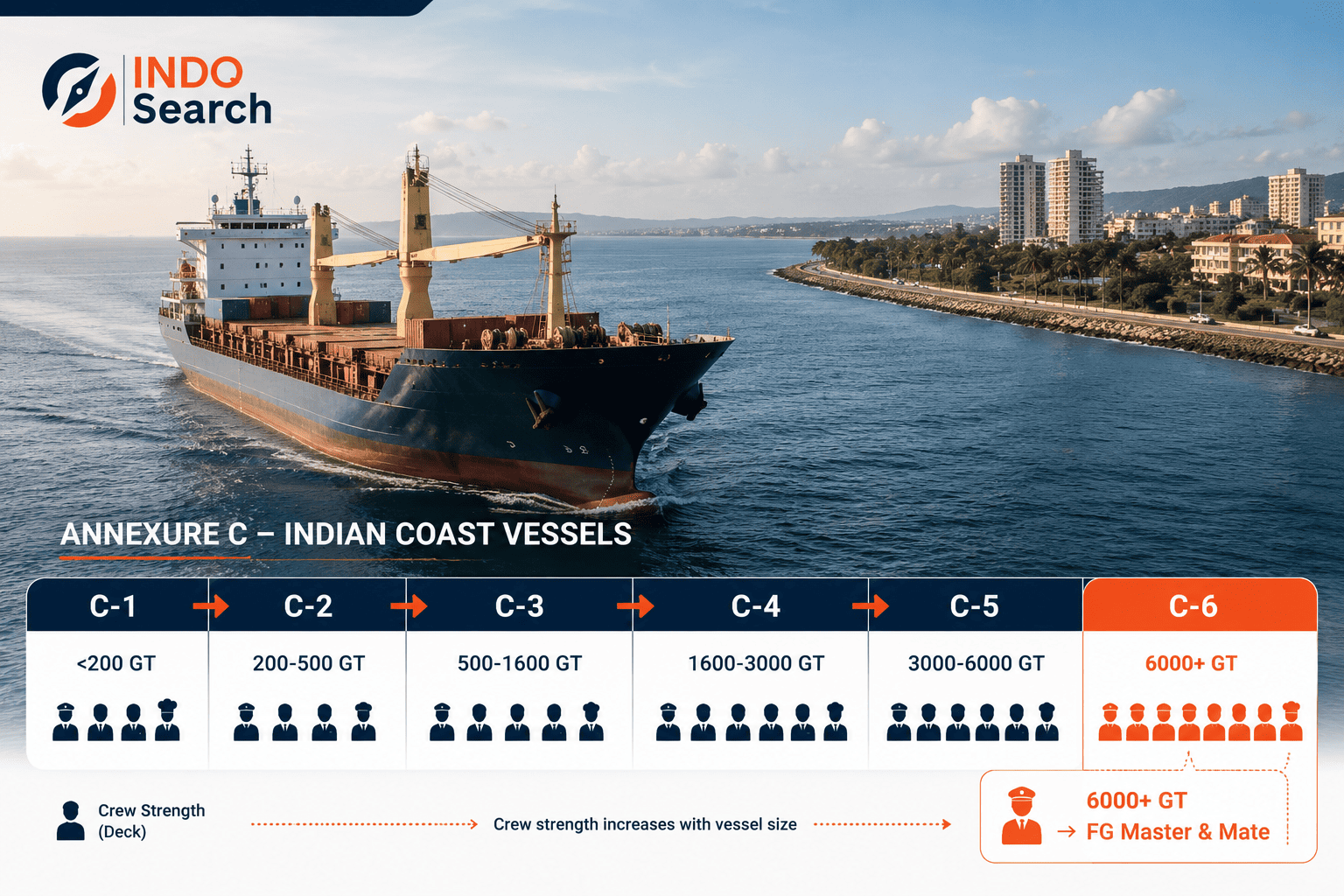
Annexure C covers self-propelled cargo and non-passenger vessels operating on the Indian coast, including the Andaman & Nicobar Islands and Lakshadweep, across six codes, C-1 through C-6. It runs one GT band finer than Annexure B, which gives it the tightest tonnage steps of any cargo scale in the circular.
| Code | GT of Vessel | Master | Chief Officer | OINW | AB | OS | Cook |
| C-1 | Below 200 | Master NCV (500 GT) / Mate NCV: 1 | NWKO NCV / 1st Class IV Master: 1 | Not required | Able Seafarer Deck II/5: 1 | Rating, Basic STCW safety training: 1 | Not required |
| C-2 | 200 to below 500 | Master NCV (500 GT) / Mate NCV, 6 months’ experience: 1 | Mate NCV: 1 | NWKO NCV / 1st Class IV Master: 1 | Able Seafarer Deck II/5: 1 | Rating, Basic STCW safety training: 1 | Basic STCW safety training + CoC as Cook: 1 |
| C-3 | 500 to below 1600 | Master NCV: 1 | Mate NCV / NWKO NCV, 1 year experience: 1 | NWKO NCV: 1 | Able Seafarer Deck II/5: 2 | Rating, Basic STCW safety training: 1 | Basic STCW safety training + CoC as Cook: 1 |
| C-4 | 1600 to below 3000 | Master NCV: 1 | Mate NCV / NWKO NCV, 1 year experience: 1 | NWKO NCV: 1 | Able Seafarer Deck II/5: 2 | Rating, Basic STCW safety training: 1 | Basic STCW safety training + CoC as Cook: 1 |
| C-5 | 3000 to below 6000 | Master NCV: 1 | Mate NCV / NWKO NCV, 2 years’ experience: 1 | NWKO NCV: 1 | Able Seafarer Deck II/5: 2 | Rating, Basic STCW safety training: 2 | Basic STCW safety training + CoC as Cook: 1 |
| C-6 | 6000 and above | Master FG: 1 | Mate FG: 1 | NWKO NCV: 1 | Able Seafarer Deck II/5: 2 | Rating, Basic STCW safety training: 2 | Basic STCW safety training + CoC as Cook: 1 |
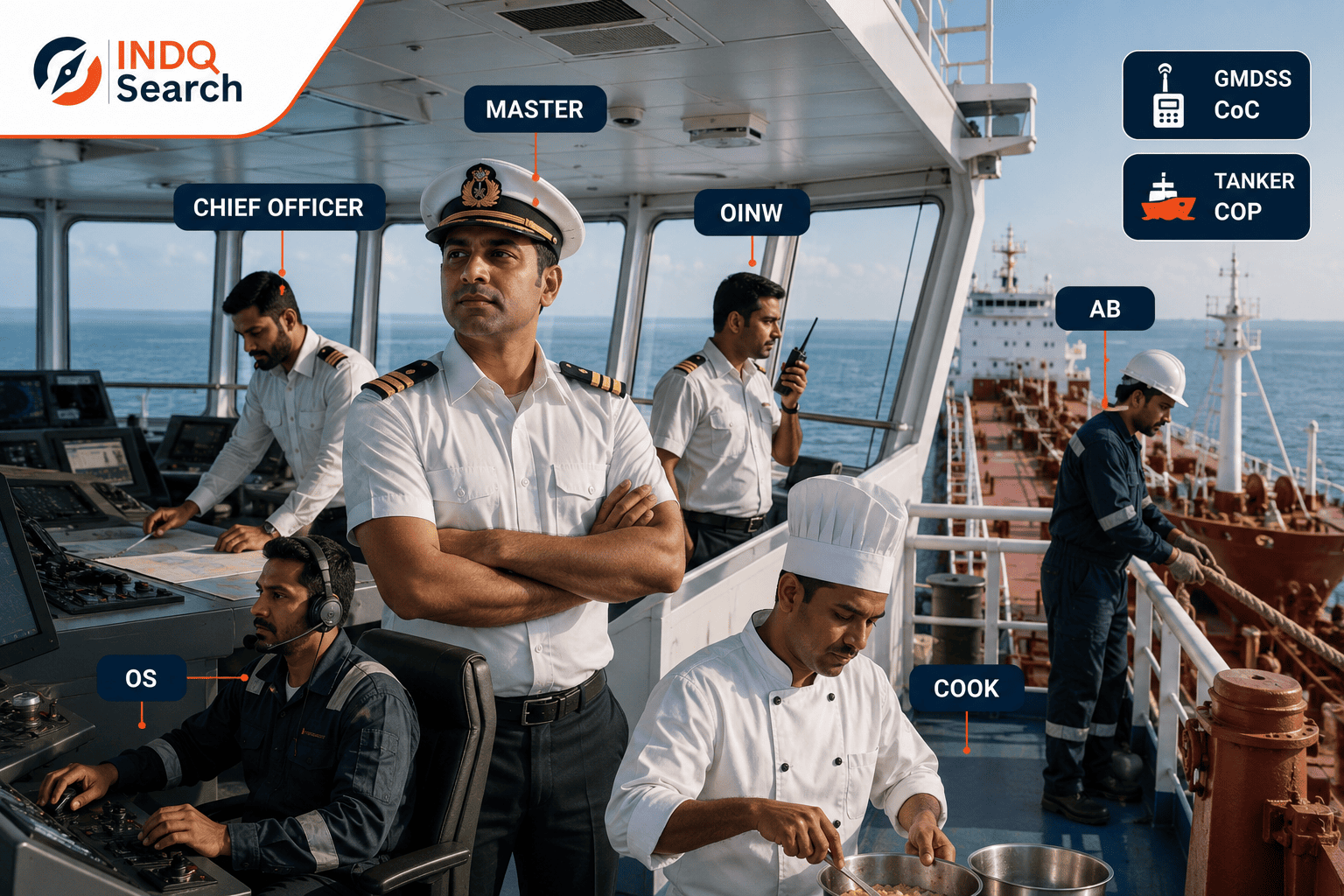
At least one officer on every vessel under this annexure must hold a valid Indian GMDSS Certificate of Competency, though Code C-1 accepts a Restricted Operator Certificate instead. Tankers need a valid Certificate of Proficiency in Tanker Operation on top of the base crew shown here.
What Changes in Crew Numbers Between Code C-1 and Code C-6?
The smallest vessels on this scale run lean. A 150 GT harbour supply craft, Code C-1, sails with just 4 nautical crew: a Master, a combined Chief Officer/watchkeeping role filled by an NWKO NCV or 1st Class IV Master, one AB, and one OS. There is no dedicated cook requirement at this size, and no separate OINW position.
By Code C-2, 200 to 500 GT, a third officer role appears. The vessel now carries a Master, a Chief Officer, and a separate OINW, alongside a cook. Crew size holds fairly steady through Codes C-3 and C-4, then adds an extra AB and OS at C-5, 3000 to 6000 GT.
The biggest jump happens at Code C-6. A 6500 GT cargo ship on this same coastal trade needs 8 nautical crew. For the first time on this scale, the Master and Mate must both hold Foreign-Going certificates instead of NCV ones, even though the vessel never leaves Indian waters.
Why Does Annexure C Add a Third Officer Earlier Than Annexure B?
This is one of the more useful details to know if you are comparing scales side by side. Under Annexure B for near coastal voyages, a dedicated OINW or NWKO position only appears from Code B-3 onward, at 500 GT. Under Annexure C, that same third officer role appears one full tonnage band earlier, at Code C-2, from 200 GT.
The practical effect is that a 300 GT vessel trading on the Indian coast needs three officers, Master, Chief Officer, and OINW, while a 300 GT vessel on a near coastal voyage under Annexure B still only needs two. Ship managers who move a vessel between these two trades sometimes assume the scales are interchangeable at the same tonnage. They are not, and this is the specific point where that assumption breaks down.
What Do the Footnote Symbols in the Annexure C Table Mean?
The original circular attaches several footnote markers to specific ranks in the Annexure C table, and each one changes the base numbers shown above in a defined situation.
- A single asterisk on Code C-1’s Master requirement ties to a footnote stating this element is not required on cargo ships, other than tankers, on voyages of less than 12 hours.
- A double asterisk on Code C-2’s Chief Officer requirement means that rank is required only on tankers.
- A triple asterisk on Code C-2’s AB requirement means one additional AB is required on tankers, and on MSV, OSV, PSV, AHTS, and SPS vessels.
- A single hash on Codes C-3 and C-4 means the Mate NCV requirement can be substituted by an NWKO (NCV) with 12 months’ experience, for vessels below 3000 GT other than tankers.
- A double hash on Codes C-3 and C-4 means the OINW requirement is not required on OSV, MSV, PSV, AHTS, SPS, tugs, or dredgers.
- A triple hash on Code C-6 means one additional officer of the same rank is required on tankers, or on any vessel for voyages exceeding 72 hours.
Dredgers get one further concession. Master, Mate, and NWKO-NCV certificates on a dredger can be substituted with Dredge Master Grade I, Dredge Master Grade II, and Dredge Mate Grade I respectively, across every code on this scale.
Does This Scale Apply to Vessels Serving the Andaman & Nicobar Islands and Lakshadweep?
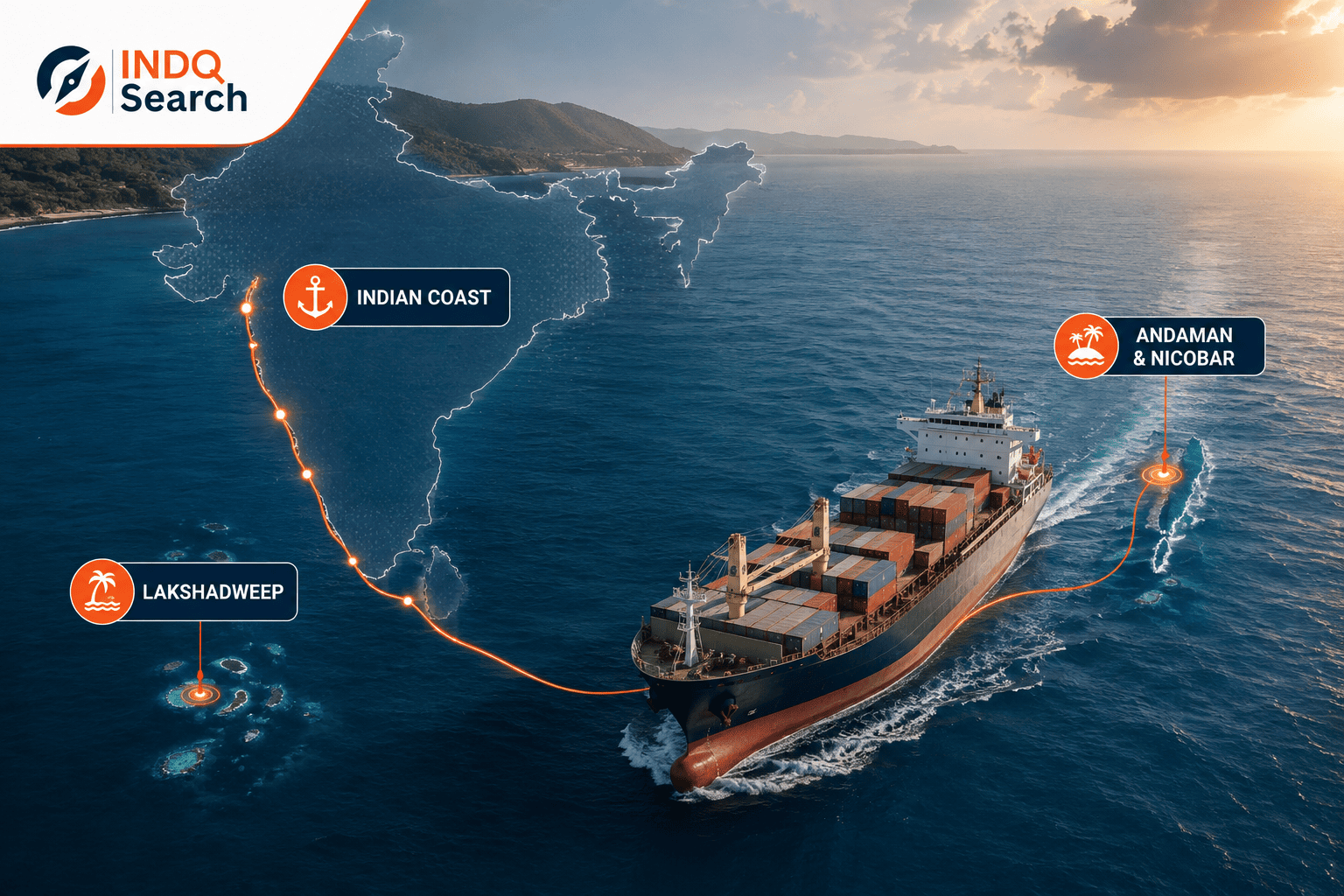
Annexure C’s title names the Andaman & Nicobar Islands and Lakshadweep specifically, and that is not a small detail. Island connectivity depends heavily on shipping. The Directorate of Shipping Services under the Andaman & Nicobar Administration alone runs dozens of vessels linking Port Blair with the outer islands. These vessels carry cargo, passengers, and essential supplies across routes that would otherwise depend on far more limited air links.
One distinction matters here. Annexure C applies to self-propelled cargo and non-passenger vessels. Passenger vessels serving the same island routes, including many inter-island ferries, fall under the separate G-series scales instead, since Annexure G governs passenger, Ro-Ro, and Ro-Pax vessels across the whole circular, coastal routes included. A cargo vessel resupplying an island port sits under Annexure C. A ferry carrying passengers on the same route sits under Annexure G instead.
What Extra Certificates Does the Indian Coast Crew Need?
Certification on Annexure C runs almost entirely on the NCV track, similar to Annexure B, with Master NCV (500 GT) or Mate NCV acceptable up to 6000 GT. Only Code C-6 requires the Master and Mate to step up to Foreign-Going certificates, which are the same qualification level required throughout Annexure A for international voyages.
Officers preparing for that FG step-up often start with a Second Mate FG course, while deck ratings working toward AB and OS positions typically begin with a GP Rating course. Officers renewing an NCV or FG Certificate of Competency can check the process in our CoC revalidation guide. Any crew member should also confirm current fitness requirements through a DGMA approved doctor before joining, a step our guide to mandatory medical tests for seafarers covers in detail.
How Is the MSMD Issued for a Vessel Under Annexure C?
The approval process matches every other annexure in the circular, and our pillar guide covers the full MSMD approval workflow in more detail. For a vessel under Annexure C specifically, the shipowner or manager submits a manning proposal, with a self-assessment checklist, online to the concerned Mercantile Marine Department.
The MMD reviews the proposal against the Annexure C code that matches the vessel’s tonnage, plus any extra crew the company proposes for island trading patterns, maintenance needs, or rest-hour compliance. Once approved, the ship sails strictly to that MSMD, and registered RPSL manning agencies place officers and ratings against the approved document, not against a generic estimate of what a similar vessel elsewhere might carry.
Can a Shipping Company Get a Dispensation From the Annexure C Manning Scale?
Only for genuine exigencies, and the process is identical across the whole circular. Our pillar guide explains the full two-stage dispensation process in detail, covering sudden illness, injury, or unavailability of a crew member.
For a vessel under Annexure C, the company applies to the Nautical Wing with full case details, including the applicable Maritime Union of India wage scale for the rank concerned. Once in-principle approval is granted, it remits the maximum basic wage for that rank. Given how many Annexure C vessels serve remote island routes, crew changes can be harder to arrange quickly, which makes it tempting to lean on dispensation. The Directorate treats it as a rare exception regardless of route, not a standing solution for a hard-to-reach posting.
How Does the Indian Coast Scale Compare With International and Near Coastal Scales?
Annexure C sits closest to Annexure B in structure, but the two are not identical.
| Scale | Annexure | Voyage Type | Entry Master Qualification | GT Bands | Third Officer Added At |
| International voyages | A | Worldwide trade, beyond near-coastal limits | Master (FG) | 4 (A-1 to A-4) | 500 GT |
| Near coastal voyages | B | Defined near-coastal zone | Master NCV (500 GT) or Mate NCV | 5 (B-1 to B-5) | 500 GT |
| Indian coast, incl. A&N and Lakshadweep | C | Indian coastline and island territories | Master NCV (500 GT) or Mate NCV | 6 (C-1 to C-6) | 200 GT |
Annexure A requires FG certificates from the smallest vessel upward, with no NCV option at any tonnage. Annexure B and Annexure C both stay on the NCV track until 6000 GT. Annexure C splits its tonnage bands more finely, though, and staffs its third officer position sooner. That reflects the shorter, more frequent port calls typical of coastal and island cargo runs, compared with a single longer near coastal passage.
What Happens If a Vessel Sails Below Its Approved Annexure C Manning Scale?
The rule is unchanged from every other scale in the circular. A ship must be crewed strictly to the numbers on its approved MSMD, and Annexure C carries no exception to that.
Inspectors checking a coastal or island trade vessel tend to focus on two things: whether the headcount matches the approved code, and whether the certificates on board match the code’s requirement, NCV versus FG, at the vessel’s actual tonnage. A vessel that has grown into a higher GT band, through re-measurement or modification, but is still sailing on an older, lighter MSMD, has a compliance gap. That gap tends to surface exactly this way, during a Port State or Flag State inspection.
FAQs
What is Annexure C of DGMA Circular No. 54 of 2025?
Annexure C is the section of the circular that sets minimum safe manning for self-propelled cargo and non-passenger vessels operating on the Indian coast, including the Andaman & Nicobar Islands and Lakshadweep, across Codes C-1 to C-6.
How many crew does a vessel under 200 GT need under Code C-1?
Code C-1 requires a Master NCV or Mate NCV, one NWKO NCV or 1st Class IV Master filling the Chief Officer role, one AB, and one OS, a total of 4 nautical crew.
What certificate does the Master need under Annexure C?
A Master NCV (500 GT) is acceptable up to 6000 GT. Above 6000 GT, under Code C-6, the Master must hold a Foreign-Going (FG) certificate instead.
Does Annexure C apply to passenger ferries serving the Andaman Islands?
No. Annexure C covers cargo and non-passenger vessels only. Passenger ferries and Ro-Ro/Ro-Pax vessels on the same coastal and island routes fall under the separate Annexure G scales.
What is the difference between Annexure B and Annexure C?
Both accept NCV certificates up to 6000 GT, but Annexure C has six GT bands instead of five and adds its third officer, the OINW or NWKO, at 200 GT rather than 500 GT.
Do tankers need extra crew under Annexure C?
Yes. Tankers require additional crew in several ranks marked with footnote symbols in the circular, plus a valid Certificate of Proficiency in Tanker Operation, on top of the base Annexure C numbers.
What GMDSS certificate does an Annexure C vessel need?
At least one officer must hold a valid Indian GMDSS Certificate of Competency. On Code C-1, vessels under 200 GT, a Restricted Operator Certificate is accepted instead.
Can Master, Mate, and NWKO certificates be substituted on a dredger?
Yes. For dredgers operating under Annexure C, Master, Mate, and NWKO-NCV certificates can be substituted with Dredge Master Grade I, Dredge Master Grade II, and Dredge Mate Grade I respectively.
Who approves the MSMD for a vessel under Annexure C?
The concerned Mercantile Marine Department reviews the shipowner’s manning proposal against the Annexure C code matching the vessel’s tonnage, then issues the MSMD once satisfied it meets the minimum and any operational needs.
Is minimum safe manning different for vessels serving Lakshadweep compared with the mainland Indian coast?
No. Annexure C applies the same GT-based codes, C-1 to C-6, regardless of whether the vessel trades along the mainland coast, the Andaman & Nicobar Islands, or Lakshadweep.