
Minimum safe manning requirements for foreign offshore areas come from Annexure E-2 of Circular No. 54 of 2025, and they set the strictest certificate standard of any offshore scale in the circular. Every vessel, even one under 200 GT, needs a master holding a foreign-going certificate. There is no NCV option anywhere on this scale, at any tonnage.
This is the manning scale that applies once an Indian-flagged offshore support vessel moves beyond India’s own waters into another country’s offshore zone, and it comes with a condition none of the other annexures carry: acceptance by the foreign maritime administration whose waters the vessel is working in. This guide continues our series on minimum safe manning requirements for Indian flag vessels, and it follows directly from our guide to Annexure E-1 for Indian offshore areas, the scale this one is most often confused with. We’ve also covered international voyages, near coastal voyages, Indian coast operations, and harbour operations elsewhere in this series.
Why Does a Separate Annexure Cover Foreign Offshore Areas?
Annexure E-2 exists for one specific, narrow situation: an Indian-flagged vessel working offshore support duty in another country’s waters, outside India’s own near-coastal zone entirely. That’s different from Annexure E-1, which stays inside the Indian EEZ, and different again from every coastal or harbour annexure we’ve covered, all of which assume the vessel never leaves Indian jurisdiction.
What Counts as a Foreign Offshore Area?
The circular’s own title for this annexure spells it out: Foreign Offshore Areas, outside the NCV area, subject to acceptance by the concerned maritime administration. In practice, this covers Indian-flagged OSVs, AHTS vessels, and similar offshore support craft working charters in places like the Persian Gulf, West Africa, or Southeast Asia, wherever an offshore oil and gas sector needs support tonnage and an Indian operator has won the work.
Why Does This Scale Need Foreign Maritime Administration Acceptance?
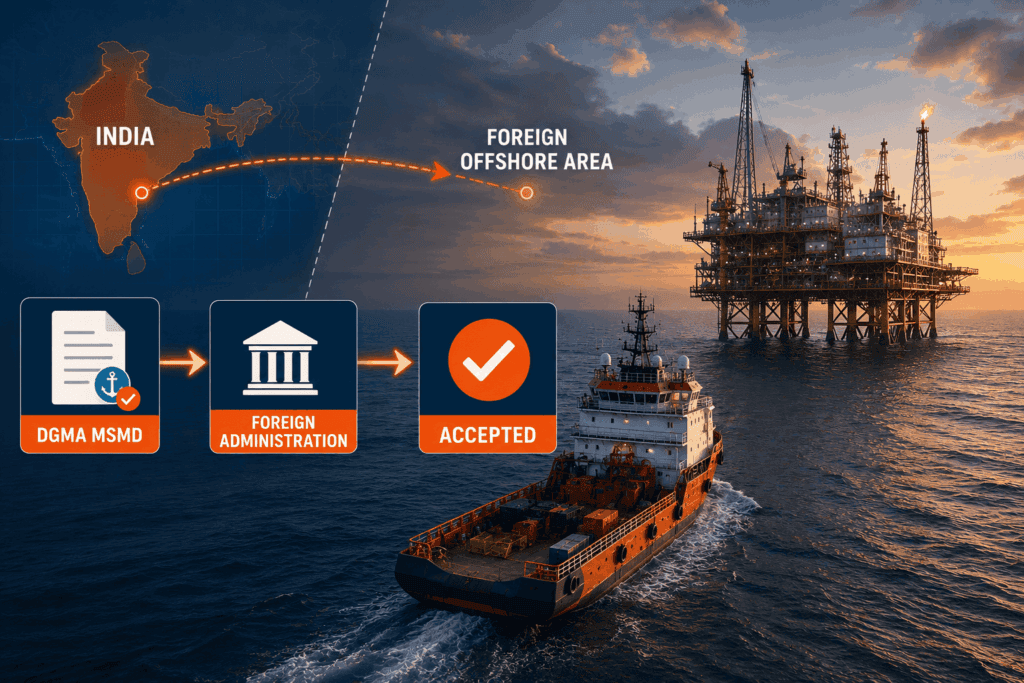
This is the detail that makes Annexure E-2 genuinely different from every other scale in the circular. A vessel operating on Annexure A, B, C, D, or E-1 only has to satisfy the DGMA, since the whole operation sits inside India’s own legal reach. A vessel operating on Annexure E-2 also needs the destination country’s own maritime administration to accept that its Indian MSMD and crew certification are good enough to work in that country’s offshore zone.
This isn’t unique to E-2 as a concept. We saw a narrower version of the same idea on Annexure B, where a tug under 500 GT can extend its NCV manning into the Persian Gulf and Singapore Straits, but only subject to acceptance by those countries’ maritime administrations. Annexure E-2 applies that same principle across an entire scale, rather than as a one-off exception for a single vessel category.
What are the minimum safe manning requirements for foreign offshore areas? (Annexure E-2)
| Code | GT of Vessel | Master | Chief Officer | OINW | AB | OS | Cook |
| E2-a | Below 200 | Master FG: 1 | 2nd Mate FG: 1 | Not required | Able Seafarer Deck II/5: 1 | Rating, Basic STCW safety training: 1 | Basic STCW safety training + CoC as Cook: 1 |
| E2-b | 200 to below 500 | Master FG: 1 | Mate FG / 2nd Mate FG, 1 year experience: 1 | Not required | Able Seafarer Deck II/5: 2 | Not required | Basic STCW safety training + CoC as Cook: 1 |
| E2-c | 500 to below 3000 | Master FG: 1 | Mate FG: 1 | Not required | Able Seafarer Deck II/5: 2 | Rating, Basic STCW safety training: 1 | Basic STCW safety training + CoC as Cook: 1 |
| E2-d | 3000 to below 6000 | Master FG: 1 | Mate FG: 1 | 2nd Mate FG: 1 | Able Seafarer Deck II/5: 2 | Rating, Basic STCW safety training: 2 | Basic STCW safety training + CoC as Cook: 1 |
| E2-e | 6000 and above | Master FG: 1 | Mate FG: 1 | 2nd Mate FG: 1 | Able Seafarer Deck II/5: 3 | Rating, Basic STCW safety training: 2 | Basic STCW safety training + CoC as Cook: 1 |
Annexure E-2 covers self-propelled cargo and non-passenger vessels working foreign offshore areas, across five codes, E2-a through E2-e, one fewer than Annexure E-1’s six.
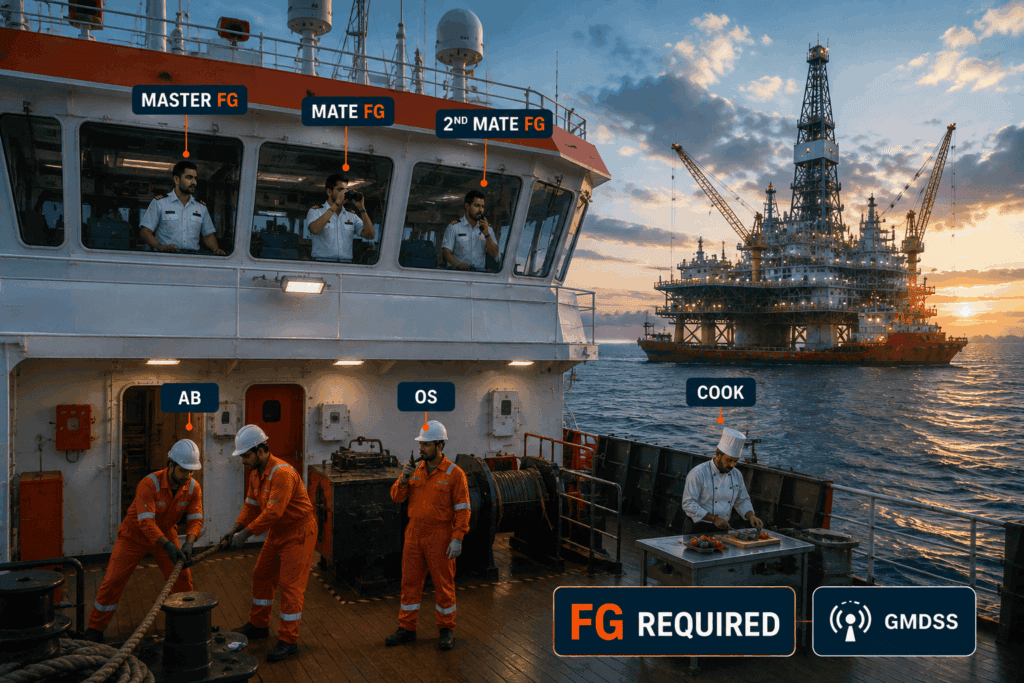
Either one dedicated Radio Officer holding a valid Indian GMDSS Certificate of Competency, or two deck officers who each hold one, must be carried on every vessel under this annexure. Tankers need a valid Certificate of Proficiency in Tanker Operation on top of the base crew shown here, and vessels under 200 GT can rely on this scale only for fair-weather operation, unless DGMA specifically authorises otherwise.
How Does the Annexure E-2 Table Structure Differ From Annexure E-1?
Annexure E-1 splits its mid-range tonnage into two separate bands, 500 to 1600 GT and 1600 to 3000 GT. Annexure E-2 merges that entire range into one code, E2-c, covering 500 to below 3000 GT with a single, unchanging crew requirement. That gives Annexure E-2 a flatter, simpler progression, five codes instead of six, even though the vessels it covers arguably work in a more demanding environment.
What Changes in Crew Numbers Between Code E2-a and Code E2-e?
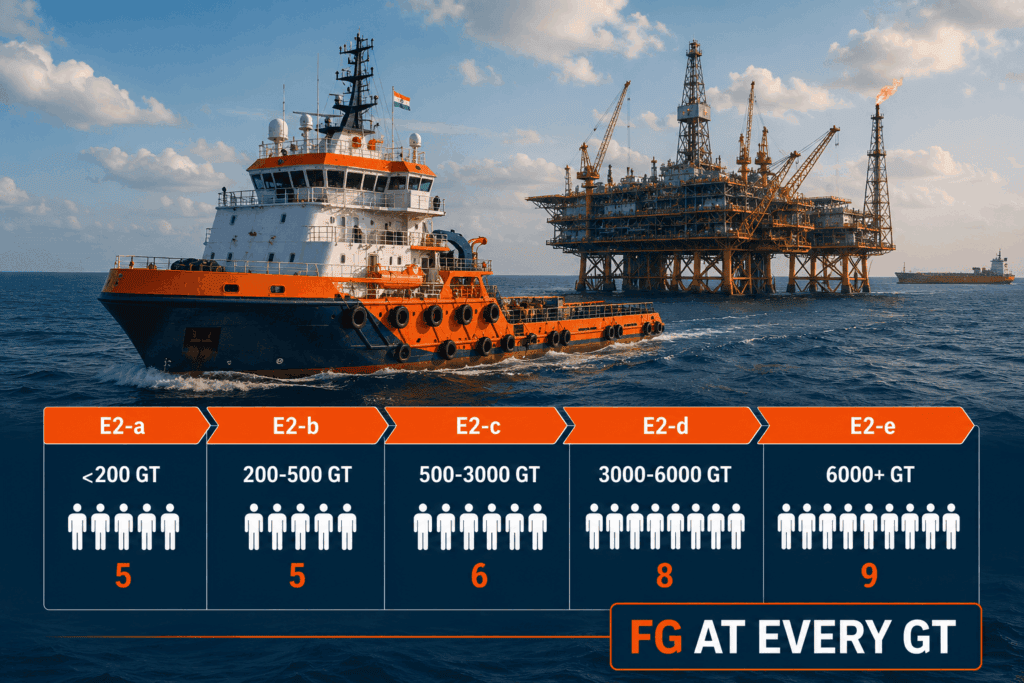
The smallest foreign offshore vessels, Code E2-a, sail with 5 nautical crew: a Master FG, a 2nd Mate FG, one AB, one OS, and a cook. Code E2-b holds the same total but shifts the mix, AB rises to 2 while OS drops to not required, an echo of the same non-linear OS pattern we flagged on Annexure E-1.
Code E2-c holds steady at 6 total crew across the widest single tonnage band in the circular, 500 to below 3000 GT. The real growth happens from Code E2-d onward. A dedicated OINW position appears at 3000 GT, taking the total to 8, and at Code E2-e, 6000 GT and above, AB climbs to 3, the highest AB requirement on any offshore annexure, bringing the total to 9, the largest crew of any code we’ve covered in this offshore cluster.
Why Does Annexure E-2 Require FG Certificates at Every Tonnage Band?
Every rank on Annexure E-2 that carries a certificate requirement specifies FG, Foreign-Going, with no NCV alternative offered anywhere on the scale, not even at Code E2-a, the smallest vessel band.
How Does This Compare With the NCV Flexibility on Annexure E-1?
This is the sharpest contrast in the whole offshore cluster. Annexure E-1 offers FG or NCV as alternatives across four tonnage bands, and only requires FG outright above 6000 GT. Annexure E-2 requires FG outright from the very first GT band. The difference comes down to where the vessel actually works. An NCV certificate is valid only within India’s designated near coastal zone. Once a vessel crosses into another country’s offshore waters, an NCV-certified officer has no standing there at all, which is exactly why the annexure’s title excludes the NCV area by name.
Which Other Annexures Share This Strict FG Requirement?
Only Annexure A, international voyages, shares this pattern elsewhere in the circular. Both A and E-2 require FG certificates at every single tonnage band, with zero NCV option at any point on the scale. That’s not a coincidence. Both scales cover vessels working entirely outside India’s near coastal and territorial-adjacent waters, whether on a genuine international voyage or in another country’s offshore zone, and both need officers holding a certificate that’s internationally recognised rather than one valid only inside India’s own NCV boundary.
Why Does Annexure E-2 Have Stricter GMDSS Requirements Than Annexure E-1?
Annexure E-1 asks for just one GMDSS-qualified officer, at every tonnage, with no further condition. Annexure E-2 goes further: either one dedicated Radio Officer holding a valid Indian GMDSS CoC, or two deck officers who each hold one, must be carried.
What Does “Two GMDSS-Qualified Officers” Actually Mean in Practice?
Option One: A Dedicated Radio Officer
A vessel can carry one officer whose primary role is radio and distress communication, holding a valid Indian GMDSS Certificate of Competency. This officer sits outside the Master, Chief Officer, and OINW headcount shown in the table above, an additional position rather than a substitute for one of them.
Option Two: Two GMDSS-Qualified Deck Officers
Alternatively, the company can satisfy the requirement by ensuring two of the vessel’s existing deck officers, typically the Master and Chief Officer, each hold a valid Indian GMDSS CoC, without adding a dedicated Radio Officer position at all. Most Indian offshore operators favour this route on smaller vessels, since it avoids carrying an extra crew member purely for communications duty.
The stricter rule makes sense given where these vessels work. A vessel in Indian offshore waters under Annexure E-1 can usually reach Indian search-and-rescue and coast radio resources reasonably quickly. A vessel working foreign offshore waters under Annexure E-2 may be operating far from any Indian communication infrastructure, coordinating instead with a foreign administration’s own resources, which raises the bar on redundant, qualified communication coverage on board.
Which Vessels and Trades Typically Operate Under Annexure E-2?
Offshore Supply Vessels, Anchor Handling Tug Supply vessels, and Platform Supply Vessels flying the Indian flag but chartered into foreign offshore markets make up the bulk of the fleet working under this annexure. Indian-owned or Indian-flagged offshore support tonnage has historically found charter work in the Persian Gulf, off West Africa, and across parts of Southeast Asia, wherever regional oil and gas activity outpaces the local offshore support fleet.
What Happens When a Vessel Moves Between Indian and Foreign Offshore Work?
This is the practical trap ship managers need to watch for on this annexure specifically. A vessel currently working under Annexure E-1 with NCV-certified officers is fully compliant inside the Indian EEZ. The moment that same vessel takes a foreign charter and moves outside the NCV area, its manning basis shifts to Annexure E-2, and those same NCV certificates no longer satisfy the requirement. The company needs FG-certified officers on board, a fresh MSMD reflecting Annexure E-2, and confirmation that the destination country’s maritime administration accepts the arrangement, all before the vessel actually starts the foreign charter, not after.
How Is the MSMD Issued for a Vessel Under Annexure E-2?
The core approval process is unchanged from the rest of the circular, and our pillar guide covers the full MSMD approval workflow in detail. The shipowner or manager submits a manning proposal, with a self-assessment checklist, online to the concerned Mercantile Marine Department.
Annexure E-2 adds one extra layer most other annexures don’t need: documented acceptance from the foreign maritime administration whose waters the vessel will work in. Companies typically gather this alongside the MSMD application rather than after it, since a charter can stall if that acceptance isn’t confirmed in time. Registered RPSL manning agencies placing crew on foreign offshore charters should confirm every officer’s FG certificate and GMDSS CoC are current well before mobilisation, and crew should hold valid medical clearance from a DGMA approved doctor, per our guide to mandatory medical tests for seafarers, along with a current BSID card for the port-side movement most foreign mobilisations still involve.
Officers who need to upgrade from NCV to FG certification before taking on Annexure E-2 work typically do so through a Second Mate FG course, listed alongside other options in our directory of DGMA-approved maritime training institutes, and existing FG holders due for renewal can check the process in our CoC revalidation guide.
Can a Shipping Company Get a Dispensation From the Foreign Offshore Manning Scale?
Only for genuine exigencies, following the same two-stage process used across the whole circular. Our pillar guide explains the full dispensation process in detail, covering sudden illness, injury, or unavailability of a crew member.
For a vessel under Annexure E-2, the company applies to DGMA’s Nautical Wing with full case details, including the applicable Maritime Union of India wage scale for the rank concerned, then remits the maximum basic wage for that rank once in-principle approval is granted.
Dispensation on a foreign offshore charter carries an extra practical complication: a replacement officer often has to travel internationally to reach the vessel, which can take longer than a domestic crew change, so companies working this annexure tend to build more lead time into their crew planning than the circular’s own process technically requires. If the underlying issue is a genuine medical emergency, checking eligibility under the SWFS welfare schemes alongside the dispensation request is worth doing at the same time.
How Does the Foreign Offshore Scale Compare With Every Other Annexure?
Six annexures into this series, the full pattern across the circular is now visible in one place.
| Scale | Annexure | Operating Area | Entry Master Qualification | GT Bands | 3rd Officer Added At | GMDSS Rule |
| International voyages | A | Worldwide trade | Master (FG) | 4 | 500 GT | Radio Officer or 2 officers |
| Near coastal voyages | B | Defined near-coastal zone | Master NCV or Mate NCV | 5 | 500 GT | Radio Officer or 2 officers |
| Indian coast, incl. A&N and Lakshadweep | C | Coastline and island territories | Master NCV or Mate NCV | 6 | 200 GT | 1 officer (ROC below 200 GT) |
| Harbour operations | D | Port limits, fair weather | Class IV Master | 7 | 3000 GT | 1 officer (ROC below 500 GT) |
| Indian offshore areas | E-1 | 20 NM to Indian EEZ | Master NCV or Mate NCV | 6 | 3000 GT | 1 officer, no exception |
| Foreign offshore areas | E-2 | Outside NCV area, foreign waters | Master (FG) | 5 | 3000 GT | Radio Officer or 2 officers |
Two things stand out looking at the whole set together. Certificate strictness tracks distance from Indian jurisdiction more than it tracks vessel size, Annexure A and Annexure E-2 both demand FG throughout regardless of tonnage, while every scale confined to Indian waters allows NCV somewhere on the table. GMDSS strictness follows a similar logic, the two-path dedicated-Radio-Officer rule shows up exactly on the annexures that take a vessel furthest from Indian shore-based support: international voyages and foreign offshore work.
What Happens If a Foreign Offshore Vessel Sails Below Its Approved Manning Scale?
The baseline rule is unchanged: a vessel must be crewed strictly to the numbers on its approved MSMD. Annexure E-2 adds a second layer of exposure that most other annexures don’t carry.
A shortfall here isn’t just a DGMA compliance issue. It can also breach the terms the foreign maritime administration accepted when it agreed to let the vessel work in its waters, and it can breach the charter contract itself, since most offshore charterers write manning compliance directly into their terms. A vessel caught short-crewed on a foreign offshore job risks losing the charter on top of any regulatory penalty, which is a sharper consequence than a similar shortfall would carry on a purely domestic annexure.
FAQs
What is Annexure E-2 of Circular No. 54 of 2025?
Annexure E-2 sets minimum safe manning for self-propelled cargo and non-passenger vessels working foreign offshore areas, outside the NCV area, subject to acceptance by the concerned foreign maritime administration, across Codes E2-a to E2-e.
How many crew does a vessel under 200 GT need under Code E2-a?
Code E2-a requires a Master FG, a 2nd Mate FG, one AB, one OS, and one cook, a total of 5 nautical crew.
Does Annexure E-2 allow NCV certificates at any tonnage?
No. Every code on this scale, from E2-a to E2-e, requires Foreign-Going certificates. There is no NCV alternative anywhere on Annexure E-2, unlike Annexure E-1, which allows NCV up to 6000 GT.
What does “subject to acceptance by the concerned Maritime Administration” mean?
It means the foreign country whose offshore waters the vessel is working in must formally accept that the vessel’s Indian MSMD and crew certification are valid for operation there, in addition to DGMA’s own approval.
What is the GMDSS requirement under Annexure E-2?
Either one dedicated Radio Officer holding a valid Indian GMDSS Certificate of Competency, or two deck officers who each hold one, must be carried on every vessel, regardless of tonnage.
What happens if a vessel moves from Indian offshore to foreign offshore work?
Its manning basis shifts from Annexure E-1 to Annexure E-2. NCV-certified officers who were compliant under E-1 no longer satisfy E-2, which requires FG certificates, and the MSMD needs reassessment before the foreign charter begins.
Which vessels typically operate under Annexure E-2?
Indian-flagged Offshore Supply Vessels, Anchor Handling Tug Supply vessels, and Platform Supply Vessels chartered into foreign offshore markets, commonly in the Persian Gulf, West Africa, or Southeast Asia.
When does a third officer appear on the foreign offshore scale?
A dedicated OINW position, filled by a 2nd Mate FG, appears from Code E2-d, 3000 GT and above, the same tonnage trigger used on Annexure D and Annexure E-1.
Why does Annexure E-2 have fewer GT codes than Annexure E-1?
Annexure E-2 merges the 500 to 1600 GT and 1600 to 3000 GT bands used on Annexure E-1 into a single code, E2-c, covering 500 to below 3000 GT with one unchanging crew requirement.
Who approves the MSMD for a vessel under Annexure E-2?
The concerned Mercantile Marine Department reviews the shipowner’s manning proposal against the correct Annexure E-2 code, alongside confirmation that the destination country’s maritime administration accepts the arrangement, before issuing the MSMD.