
Minimum safe manning requirements for Indian offshore vessels come from Annexure E-1 of Circular No. 54 of 2025, and they cover ships working the zone between 20 nautical miles off the Indian coast and the outer edge of India’s Exclusive Economic Zone. A vessel under 200 GT needs 5 nautical crew. A vessel at 6000 GT or above needs 8, with Foreign-Going certificates required at Master and Mate level.
This is the scale that governs most of India’s offshore support fleet, the OSVs, PSVs, AHTS vessels, and tugs that service oil and gas platforms far enough offshore to fall outside near coastal limits. This guide continues our series on minimum safe manning requirements for Indian flag vessels, which maps the full circular annexure by annexure.
It opens the offshore cluster in that series, alongside the scales we’ve already covered for international voyages, near coastal voyages, Indian coast operations, and harbour operations. Every Indian flag vessel working offshore support needs to know exactly where it sits on this scale before its Minimum Safe Manning Document can be approved.
Why Does DGMA Treat Indian Offshore Areas as Their Own Category?
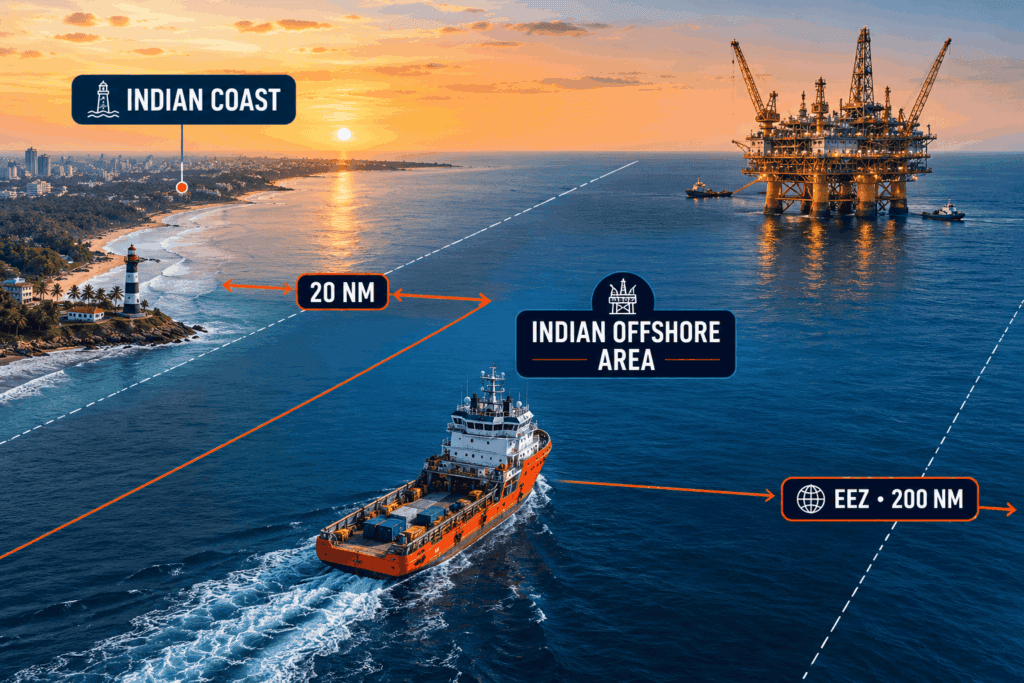
The circular itself defines the term precisely: Indian offshore areas mean the area between 20 nautical miles from the Indian coast and up to the Indian Exclusive Economic Zone. That’s a geography built around distance from shore, not voyage type or port confinement, which is exactly why it needed its own annexure rather than folding into Annexure B or Annexure C.
Where Does the 20 Nautical Mile Boundary Come From?
Twenty nautical miles roughly marks where India’s near coastal and territorial-adjacent traffic gives way to genuine offshore work, support runs to platforms, rigs, and subsea infrastructure that sit well clear of the coastline. A vessel operating inside that 20 NM line falls under Annexure B or C instead, even if its actual job looks identical to offshore support work closer to shore.
What Marks the Outer Edge at the Indian EEZ?
India’s Exclusive Economic Zone extends up to 200 nautical miles from the coastal baseline, and it’s within this zone that most of India’s producing offshore fields sit. ONGC’s Mumbai High field, the country’s largest and most productive offshore oil field, lies roughly 86 nautical miles off the Mumbai coast. That places it comfortably inside the EEZ and well beyond the 20 NM threshold, which puts the OSVs and support craft working it squarely under Annexure E-1.
The legal basis stays consistent with the rest of the circular. IMO Resolution A.1047(27) sets the global minimum safe manning framework, SOLAS Chapter V Regulation 14 makes a manning document mandatory, and the Merchant Shipping Act gives DGMA, the Directorate General of Maritime Administration, the authority to enforce it domestically. The document itself is still cited by its original title, Circular No. 54 of 2025, since it was issued in December 2025 by the Directorate General of Shipping, before that authority’s rename to DGMA in June 2026.
What are the minimum safe manning requirements for Indian offshore vessels? (Annexure E-1)
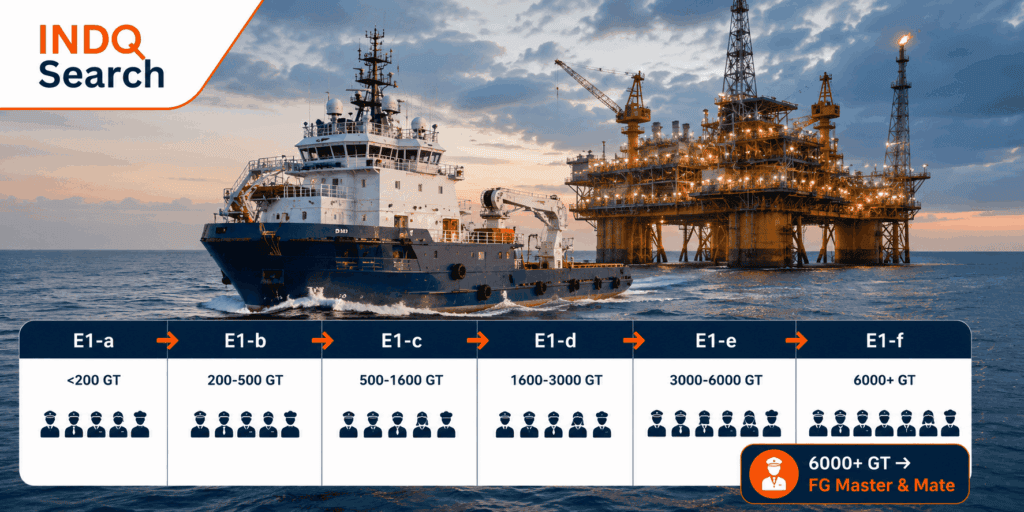
Annexure E-1 covers self-propelled cargo and non-passenger vessels working in Indian offshore areas, across six codes, E1-a through E1-f.
| Code | GT of Vessel | Master | Chief Officer | OINW | AB | OS | Cook |
| E1-a | Below 200 | Master NCV (500 GT) / Mate NCV: 1 | 2nd Mate FG / NWKO NCV: 1 | Not required | Able Seafarer Deck II/5: 1 | Rating, Basic STCW safety training: 1 | Basic STCW safety training + CoC as Cook: 1 |
| E1-b | 200 to below 500 | Master NCV (500 GT) / Mate NCV, 6 months’ experience: 1 | 2nd Mate FG / NWKO NCV, 1 year experience: 1 | Not required | Able Seafarer Deck II/5: 2 | Not required | Basic STCW safety training + CoC as Cook: 1 |
| E1-c | 500 to below 1600 | Master FG / Master NCV: 1 | Mate FG / Mate NCV / NWKO NCV, 18 months’ experience: 1 | Not required | Able Seafarer Deck II/5: 2 | Rating, Basic STCW safety training: 1 | Basic STCW safety training + CoC as Cook: 1 |
| E1-d | 1600 to below 3000 | Master FG / Master NCV: 1 | Mate FG / Mate NCV: 1 | Not required | Able Seafarer Deck II/5: 2 | Rating, Basic STCW safety training: 1 | Basic STCW safety training + CoC as Cook: 1 |
| E1-e | 3000 to below 6000 | Master FG / Master NCV: 1 | Mate FG / Mate NCV: 1 | 2nd Mate FG / NWKO: 1 | Able Seafarer Deck II/5: 2 | Rating, Basic STCW safety training: 1 | Basic STCW safety training + CoC as Cook: 1 |
| E1-f | 6000 and above | Master FG: 1 | Mate FG: 1 | 2nd Mate FG / NWKO: 1 | Able Seafarer Deck II/5: 2 | Rating, Basic STCW safety training: 2 | Basic STCW safety training + CoC as Cook: 1 |
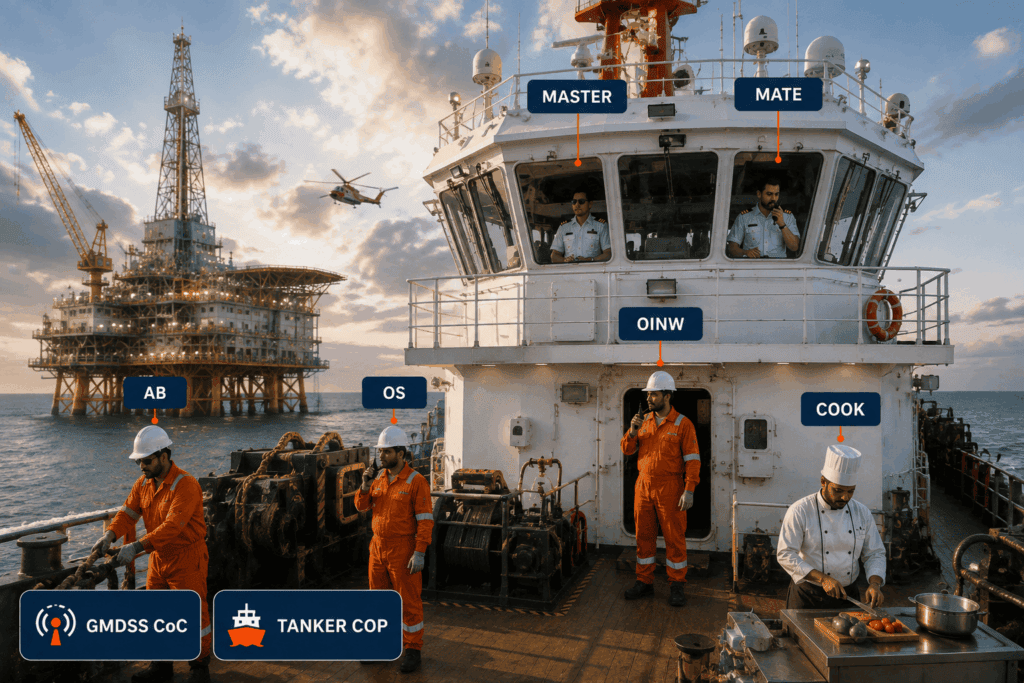
At least one officer on every vessel under this annexure must hold a valid Indian GMDSS Certificate of Competency, with no exception for smaller vessels. Tankers need a valid Certificate of Proficiency in Tanker Operation on top of the base crew shown here. Vessels under 200 GT can rely on this scale only for fair-weather operation, unless DGMA specifically authorises otherwise, the same condition that runs through nearly every annexure in the circular, from near coastal voyages down to harbour operations.
What Does the Single Footnote in the Annexure E-1 Table Mean?
Annexure E-1’s table carries none of the hash-symbol modifiers found on Annexure C or Annexure D. Its only real modifiers sit inside the qualification descriptions themselves, the experience clauses attached to Codes E1-b and E1-c, rather than separate footnoted symbols layered on top of a base number. That makes this one of the more straightforward tables in the whole circular to read at a glance.
What Changes in Crew Numbers Between Code E1-a and Code E1-f?
The smallest offshore vessels, Code E1-a, sail with 5 nautical crew: a Master, a second officer role filled by either a 2nd Mate FG or an NWKO NCV, one AB, one OS, and a cook. Code E1-b holds the same total, but the mix shifts, AB doubles to 2 while OS drops entirely.
Why Does the OS Requirement Drop to Zero at Code E1-b?
This is one of the few places in the entire circular where a crew number moves in the opposite direction from tonnage. Every other rank on this scale, and nearly every rank across Annexures A through D, holds steady or grows as GT increases. OS at Code E1-b briefly disappears, before returning at 1 from Code E1-c onward and rising to 2 at the top tier, Code E1-f. The circular doesn’t explain the dip, but it’s worth flagging to a crewing team specifically. It’s easy to assume every rank should scale upward in step with tonnage on this annexure, and OS on Codes E1-a and E1-b is the one place that assumption breaks.
From Code E1-e, 3000 GT, a dedicated OINW position appears for the first time, and the crew total reaches 7. By Code E1-f, 6000 GT and above, the total reaches 8, with every officer position now requiring a Foreign-Going certificate.
What Certificates Appear on the Indian Offshore Scale?
Annexure E-1 mixes certificate types more freely than any annexure we’ve covered so far in this series.
Where Does Annexure E-1 Allow FG and NCV as Alternatives?
Certificate Flexibility at the Smallest Tier
Even at Code E1-a, the smallest vessel band, the second officer position accepts either a 2nd Mate FG or an NWKO NCV certificate, an either/or choice that doesn’t appear until much higher tonnage on Annexure B or Annexure C. The Master position at this tier stays NCV-only, though, so the flexibility isn’t uniform even within a single code.
Certificate Flexibility From 500 GT to 6000 GT
From Code E1-c through E1-e, both the Master and Chief Officer positions offer FG or NCV as genuine alternatives, a four-tonnage-band window of flexibility that’s wider than anything on Annexure D, where the FG-or-NCV choice appears at only one code. Only at Code E1-f, 6000 GT and above, does the scale require Foreign-Going certificates outright, with no NCV alternative left.
Officers building toward that FG standard typically train through a Second Mate FG course, and our directory of DGMA-approved maritime training institutes lists where to find one. Ratings can build their base qualification through a GP Rating course, and officers due for renewal on either the FG or NCV track can check the process in our CoC revalidation guide.
Why Does Annexure E-1 Skip the Small-Vessel GMDSS Concession?
Annexure C accepts a Restricted Operator Certificate on its smallest vessels instead of a full Indian GMDSS Certificate of Competency. Annexure D does the same below 500 GT. Annexure E-1 offers no such concession at any tonnage. Every vessel, regardless of size, needs at least one officer holding the full GMDSS CoC.
The reasoning tracks the operating environment. A small vessel working inside a harbour or close along the coast can reach assistance quickly if something goes wrong. A small vessel 60 or 80 nautical miles offshore, supporting a platform in open water, cannot, which is exactly the kind of risk difference IMO Resolution A.1047(27) expects a flag administration to weigh when setting communication equipment and qualification requirements.
Which Vessels Actually Work Under Annexure E-1?
Annexure E-1 applies to any self-propelled, non-passenger vessel working the 20 NM to EEZ zone, but in practice, one sector dominates: offshore oil and gas support.
Offshore Support Vessels Serving India’s Oil and Gas Fields
Offshore Supply Vessels, Platform Supply Vessels, Anchor Handling Tug Supply vessels, and multi-purpose support craft ferry crew, equipment, and supplies to platforms across India’s producing offshore basins. That includes the western offshore fields anchored by Mumbai High, along with the Krishna-Godavari and Cauvery basins on the east coast. These vessels rarely carry cargo in the conventional sense, but they carry crew and equipment on tight schedules, often working multiple platforms in a single rotation, which is part of why the circular keeps GMDSS requirements strict across every tonnage band on this scale.
Dredgers and tankers working the same offshore zone also fall under Annexure E-1. Both carry the same additional requirements found elsewhere in the circular: Dredge Master and Dredge Mate grade substitutions for the former, and a valid Certificate of Proficiency in Tanker Operation for the latter.
Why Does Rotation Pattern Matter More Here Than on Other Annexures?
Offshore support work runs on rotation, typically a fixed number of weeks on board followed by a fixed number of weeks off, rather than the voyage-by-voyage pattern common on cargo trades. That rotation structure interacts with rest-hour rules under STCW and the Maritime Labour Convention in a way our guide to maritime conventions for Indian seafarers explains in more depth. A vessel technically compliant with its Annexure E-1 minimum can still fall short of rest-hour compliance if rotation scheduling isn’t planned carefully around it. That’s exactly the kind of gap the circular’s own instruction to add crew “wherever operational needs demand it” is meant to close.
What Training Do Charterers Require Beyond the Circular’s Minimum?
Annexure E-1 sets the legal floor, but oil and gas operators chartering offshore support vessels routinely add their own conditions on top of it. Crew working close to a manned platform are commonly expected to hold Basic Offshore Safety Induction and Emergency Training (BOSIET), including Helicopter Underwater Escape Training, even though neither certificate appears anywhere in DGMA’s circular. None of this changes the Annexure E-1 headcount, but it’s worth budgeting for separately, since a vessel can meet every manning number on this table and still fail a charterer’s own boarding requirements if its crew lacks the operator-specific safety training the contract demands.
How Is the MSMD Issued for a Vessel Under Annexure E-1?
The approval process matches every other annexure in the circular, and our pillar guide covers the full MSMD approval workflow in detail. The shipowner or manager submits a manning proposal, with a self-assessment checklist, online to the concerned Mercantile Marine Department.
For an offshore support vessel specifically, the MMD checks the proposed crew against the correct E1 code for the vessel’s tonnage, and against the vessel’s actual working pattern, since offshore charter contracts often specify rest-hour and crew-change terms that go beyond the circular’s bare minimum. Registered RPSL manning agencies that specialise in offshore crewing build their placement plans around both the approved MSMD and the charterer’s own operational requirements.
Crew mobilising to an offshore vessel usually pass through a base port before a helicopter or crew-boat transfer out to the platform, which means standard port documentation still applies even though the working location itself sits well offshore. Every crew member needs a current Biometric Seafarer’s Identity Document for that port-side movement, covered in our guide to how to get a BSID card, and current medical clearance from a DGMA approved doctor, per our guide to mandatory medical tests for seafarers.
Can a Shipping Company Get a Dispensation From the Indian Offshore Manning Scale?
Only for genuine exigencies, following the same two-stage process that runs across the whole circular. Our pillar guide explains the full dispensation process in detail, covering sudden illness, injury, or unavailability of a crew member.
For a vessel under Annexure E-1, the company applies to DGMA’s Nautical Wing with full case details, including the applicable Maritime Union of India wage scale for the rank concerned, then remits the maximum basic wage for that rank once in-principle approval is granted.
Offshore crew changes carry a logistical wrinkle that harbour or coastal vessels don’t: getting a replacement officer out to a platform-support vessel often means coordinating a helicopter transfer or a dedicated crew boat run, not just a walk down the gangway. That makes forward planning for crew rotation more valuable here than almost anywhere else in the circular, and it’s also worth checking whether an affected seafarer qualifies for support under one of the SWFS welfare schemes if the dispensation is tied to a medical emergency.
How Does the Indian Offshore Scale Compare With Other Annexures?
Five annexures into this series, a clear pattern has emerged: certificate flexibility tends to track how far a vessel operates from shelter, and how much external support is available if something goes wrong.
| Scale | Annexure | Operating Area | Entry Master Qualification | GT Bands | Third Officer Added At |
| International voyages | A | Worldwide trade | Master (FG) | 4 (A-1 to A-4) | 500 GT |
| Near coastal voyages | B | Defined near-coastal zone | Master NCV (500 GT) or Mate NCV | 5 (B-1 to B-5) | 500 GT |
| Indian coast, incl. A&N and Lakshadweep | C | Coastline and island territories | Master NCV (500 GT) or Mate NCV | 6 (C-1 to C-6) | 200 GT |
| Harbour operations | D | Port limits, fair weather | 1st or 2nd Class IV Master | 7 (D-1 to D-7) | 3000 GT |
| Indian offshore areas | E-1 | 20 NM from coast to Indian EEZ | Master NCV (500 GT) or Mate NCV | 6 (E1-a to E1-f) | 3000 GT |
Annexure E-1 sits closest to Annexure D on where the third officer appears, both wait until 3000 GT, but the two scales diverge sharply on certificate range. Annexure D leans on lower-tier Class IV certificates for its smallest vessels. Annexure E-1 offers FG and NCV as alternatives from a much earlier tonnage band, reflecting a workforce that moves between coastal and genuinely offshore assignments more often than a harbour-confined crew does.
One more distinction worth knowing if your fleet works offshore: Annexure E-1 only covers Indian offshore areas, inside the Indian EEZ. A vessel that moves further out, into foreign offshore waters beyond the near coastal zone, falls under a separate scale, Annexure E-2, which we’ll cover in the next guide in this series.
What Happens If an Offshore Support Vessel Sails Below Its Approved Manning Scale?
The same rule applies here as across the rest of the circular. A vessel must be crewed strictly to the numbers on its approved MSMD, and Annexure E-1 carries no exception.
Offshore work adds one practical wrinkle inspectors watch for closely: GMDSS compliance. Since Annexure E-1 has no small-vessel concession, even a modest OSV working close to the 20 NM line must carry a fully GMDSS-qualified officer, not a Restricted Operator Certificate holder. A vessel that transferred in from harbour or near coastal work, where a lighter certificate was acceptable, and continues sailing on its old MSMD after moving offshore, is exactly the kind of gap a Port State or DGMA inspection tends to catch.
FAQs
What is Annexure E-1 of Circular No. 54 of 2025?
Annexure E-1 sets minimum safe manning for self-propelled cargo and non-passenger vessels working Indian offshore areas, the zone between 20 nautical miles from the Indian coast and the outer edge of the Indian EEZ, across Codes E1-a to E1-f.
How many crew does a vessel under 200 GT need under Code E1-a?
Code E1-a requires a Master NCV or Mate NCV, a second officer role filled by a 2nd Mate FG or NWKO NCV, one AB, one OS, and one cook, a total of 5 nautical crew.
What certificate does the Master need under Annexure E-1?
NCV certificates are acceptable up to 500 GT. From 500 GT to below 6000 GT, Master FG or Master NCV are both accepted as alternatives. Above 6000 GT, only a Master FG certificate qualifies.
Do small vessels get a GMDSS concession under Annexure E-1?
No. Unlike Annexure C and Annexure D, Annexure E-1 requires at least one officer to hold a full Indian GMDSS Certificate of Competency at every tonnage, with no Restricted Operator Certificate option.
Which vessels typically operate under Annexure E-1?
Offshore Supply Vessels, Platform Supply Vessels, Anchor Handling Tug Supply vessels, and similar craft supporting oil and gas platforms in India’s offshore fields, along with dredgers and tankers working the same 20 NM to EEZ zone.
What is the Indian EEZ boundary for offshore manning purposes?
The Indian Exclusive Economic Zone extends up to 200 nautical miles from the coastal baseline. Annexure E-1 covers the area between 20 nautical miles from the coast and this outer EEZ limit.
Why does the OS requirement drop at Code E1-b?
The circular doesn’t explain it, but the table shows OS at 1 for Code E1-a, dropping to not required at Code E1-b, before returning at Code E1-c. It’s one of the few non-linear crew changes in the entire circular.
When does a third officer appear on the Indian offshore scale?
A dedicated OINW position appears from Code E1-e, 3000 GT and above, the same tonnage trigger used on Annexure D for harbour operations.
Do tankers need extra crew under Annexure E-1?
Yes, in the sense that every tanker under this annexure needs a valid Certificate of Proficiency in Tanker Operation on top of the base crew shown for its GT code.
Who approves the MSMD for an offshore support vessel?
The concerned Mercantile Marine Department reviews the shipowner’s manning proposal against the correct Annexure E-1 code for the vessel’s tonnage before issuing the MSMD.