
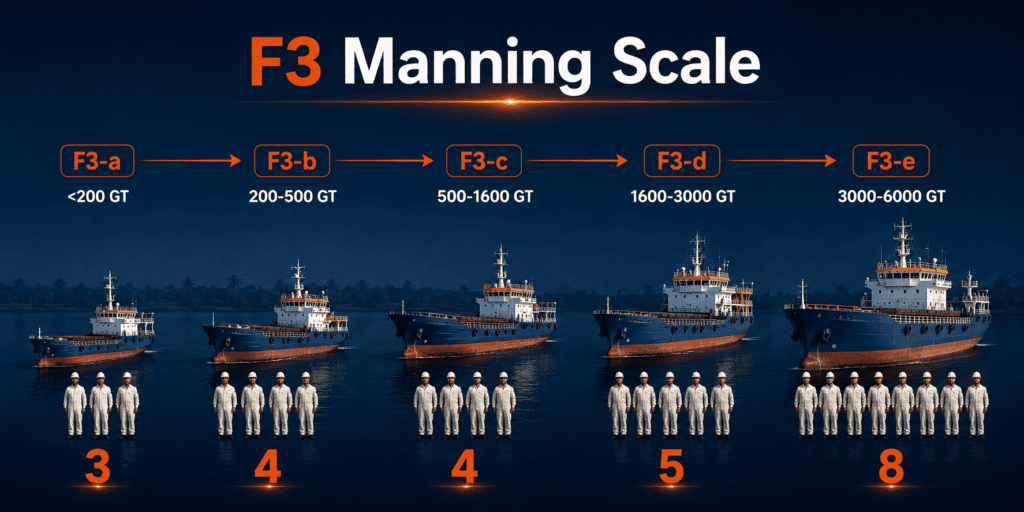
Minimum safe manning requirements for River-Sea Vessels Type 1 come from Annexure F-3 of Circular No. 54 of 2025. The scale covers five GT bands, from F3-a to F3-e. The minimum crew increases from 3 persons for vessels below 200 GT to 8 persons for vessels of 3000 GT and above but below 6000 GT.
River-Sea Vessels, RSVs, are a distinct vessel classification from the Indian Coastal Vessels we covered in our last two guides, and this is the first of five posts covering their manning scales, Annexures F-3 through F-7. This guide continues our series on minimum safe manning requirements for Indian flag vessels, building on what we’ve already published for ICV harbour operations and ICV coastal operations. It also builds on the earlier guides covering international voyages, near coastal voyages, Indian coast operations under Annexure C, harbour operations under Annexure D, and both Indian and foreign offshore areas.
What Is a River-Sea Vessel (RSV)?
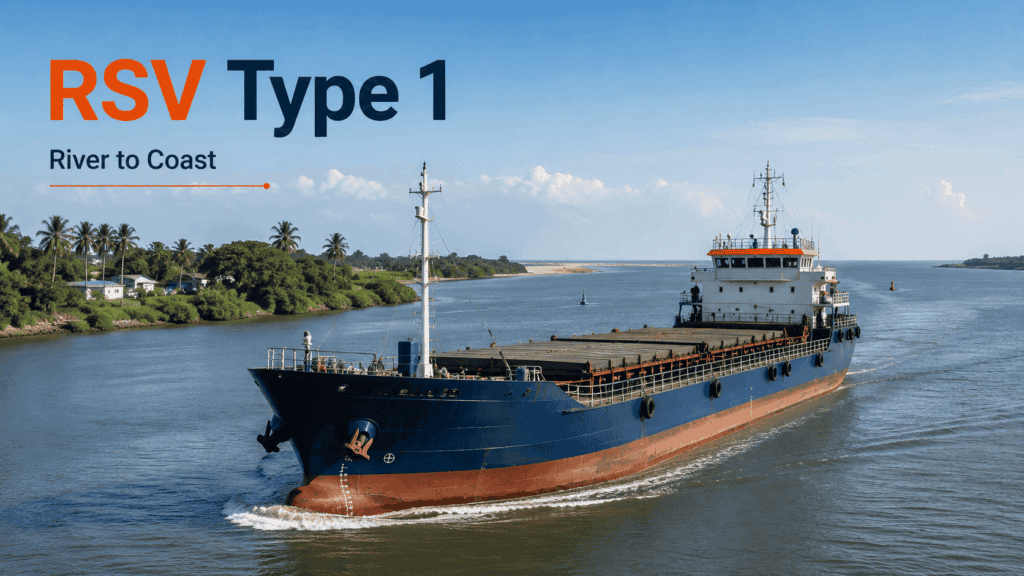
A river-sea vessel is a vessel built to move between inland waterways and the coast, a hybrid category that lets operators run one vessel across both environments instead of transhipping cargo between an inland barge and a coastal ship. India formalised this category through DG Shipping Order No. 18 of 2013, which introduced construction, survey, and certification rules for Indian River-Sea Vessels across four types, and Circular No. 54 of 2025 carries that same four-type structure into its own manning scales.
How Does an RSV Differ From an Indian Coastal Vessel (ICV)?
Both RSVs and ICVs share the same type-based GT ceilings: 3000 MT for tankers, 6000 MT for cargo vessels, and 10,000 MT for dredgers, and both sit outside the standard Annexure A to E-2 framework. The difference is construction and route. An ICV is built and classed as a coastal trader from the outset. An RSV is built to inland waterway standards, for Types 1 and 2, or a reduced steel-ship standard, for Types 3 and 4, specifically so it can also handle a coastal or river-mouth passage that a pure inland vessel couldn’t manage safely.
The legal basis behind Annexure F-3, like every other scale in this circular, runs through IMO Resolution A.1047(27) and SOLAS Chapter V Regulation 14, with the Merchant Shipping Act giving DGMA, the Directorate General of Maritime Administration, the authority to set and enforce it for every Indian flag vessel, RSV or otherwise.
What Are RSV Types 1 Through 4?
The four types split by operating range and voyage duration, not by tonnage.
The Two Most Restricted Types
Type 1 vessels are limited to ship-to-shore operations up to 12 nautical miles beyond inland vessel limits, in fair weather only, the most restricted operating envelope of the four, and the subject of this guide. Type 2 vessels ply between nearby ports in fair weather, during daylight hours only, a modest step up in range but still tightly bounded by conditions.
The Two Wider-Ranging Types
Type 3 vessels run voyages between Indian ports where the duration doesn’t exceed 24 hours, covered under Annexures F-5 and F-6 later in this series. Type 4 vessels operate without that restriction at all, covered separately under Annexure F-7, the widest-ranging RSV category in the circular.
Why Does Annexure F-3 Cover Type 1 RSVs “Including Harbour Operation”?
Because a Type 1 RSV’s entire operating envelope already sits close to what the rest of the circular calls harbour operation. A vessel limited to 12 nautical miles beyond inland limits, in fair weather only, rarely does anything that looks meaningfully different from the harbour and near-shore work covered under Annexure D or Annexure F-1. Rather than write a separate harbour-only scale for Type 1 RSVs, the circular folds that operation directly into Annexure F-3.
What Is the Operating Envelope for a Type 1 RSV?
In practice, this covers ship-to-shore transfer work, feeder runs between an inland river system and a coastal terminal, and similar short, sheltered voyages, always in fair weather and always within that 12 nautical mile boundary. It’s a narrower envelope than the six-nautical-mile port buffer used on Annexure F-1, but a wider one than staying strictly inside notified port limits, since Type 1 status is defined by the vessel’s classification and voyage pattern generally, not by a specific port boundary alone.
What are the minimum safe manning requirements for river-sea vessels Type 1? (Annexure F-3)
Annexure F-3 covers Type 1 River-Sea Vessels, including harbour operation, across five codes, F3-a through F3-e.
| Code | GT of Vessel | Master | Chief Officer | OINW | AB | OS | Cook |
|---|---|---|---|---|---|---|---|
| F3-a | Below 200 GT | 1 | 1 | – | – | 1 | – |
| F3-b | ≥200 to <500 GT | 1 | 1 | – | – | 2 | – |
| F3-c | ≥500 to <1600 GT | 1 | 1 | – | – | 1 | 1 |
| F3-d | ≥1600 to <3000 GT | 1 | 1 | – | – | 2 | 1 |
| F3-e | ≥3000 to <6000 GT | 1 | 1 | 1 | 2 | 2 | 1 |
This gives a total minimum manning of 3 crew for F3-a, 4 for F3-b, 4 for F3-c, 5 for F3-d, and 8 for F3-e. The qualification requirements for each position must be read together with the applicable F-3 row in the circular.
| Code | Key qualification requirements |
|---|---|
| F3-a | Master: 1st Class IV Master / 2nd Class I/V Master with 1 year experience. Chief Officer: 2nd Class IV Master. |
| F3-b | Master: 1st Class IV Master. Chief Officer: 2nd Class IV Master. |
| F3-c | Master: NWKO (NCV) / 1st Class IV Master with 1 year experience. Chief Officer: 1st Class IV Master / 2nd Class I/V Master with 1 year experience. |
| F3-d | Master: NWKO (NCV). Chief Officer: 1st Class IV Master / 2nd Class I/V Master with 1 year experience. |
| F3-e | Master: Master NCV / Mate NCV with 6 months’ experience. Chief Officer: NWKO (NCV) with 1 year experience. |
What Changes in Crew Numbers Between Code F3-a and Code F3-e?
How Do Crew Requirements Change for F3-a and F3-b?
Codes F3-a and F3-b cover Type 1 RSVs below 500 GT, but their manning requirements are different. F3-a requires 3 crew, comprising one master, one chief officer and one OS. F3-b requires 4 crew, comprising one master, one chief officer and two OS. Neither code requires an OINW, AB or Cook. F3-a requires 3 crew, while F3-b requires 4. The difference comes from the additional OS requirement in the F3-b band.
Crew requirements rise overall across the F-3 scale, from 3 crew in F3-a to 8 crew in F3-e. F3-a requires 3 crew, F3-b requires 4, F3-c requires 4, F3-d requires 5, and F3-e requires 8. A Cook first appears in F3-c, while an OINW and AB are added in F3-e. Code F3-e, covering 3000 GT to below 6000 GT, requires 8 crew: one master, one chief officer, one OINW, two AB, two OS and one cook.
What Certificates Appear on the Type 1 RSV Scale?
Annexure F-3 uses Class IV and NCV qualifications across its five GT bands. F3-a requires a 1st Class IV Master or a 2nd Class I/V Master with one year of experience, while the Chief Officer position requires a 2nd Class IV Master. The higher GT bands progressively introduce NCV qualifications, as specified in the table.
Officers building toward NCV certification can find course listings in our directory of DGMA-approved maritime training institutes, ratings build their base qualification through a GP Rating course, and the STCW standards behind these certificate tracks are covered in our guide to maritime conventions for Indian seafarers. Officers due for renewal can check the process in our CoC revalidation guide.
Why Does the GMDSS Threshold Sit at 1600 GT Instead of 500 GT?
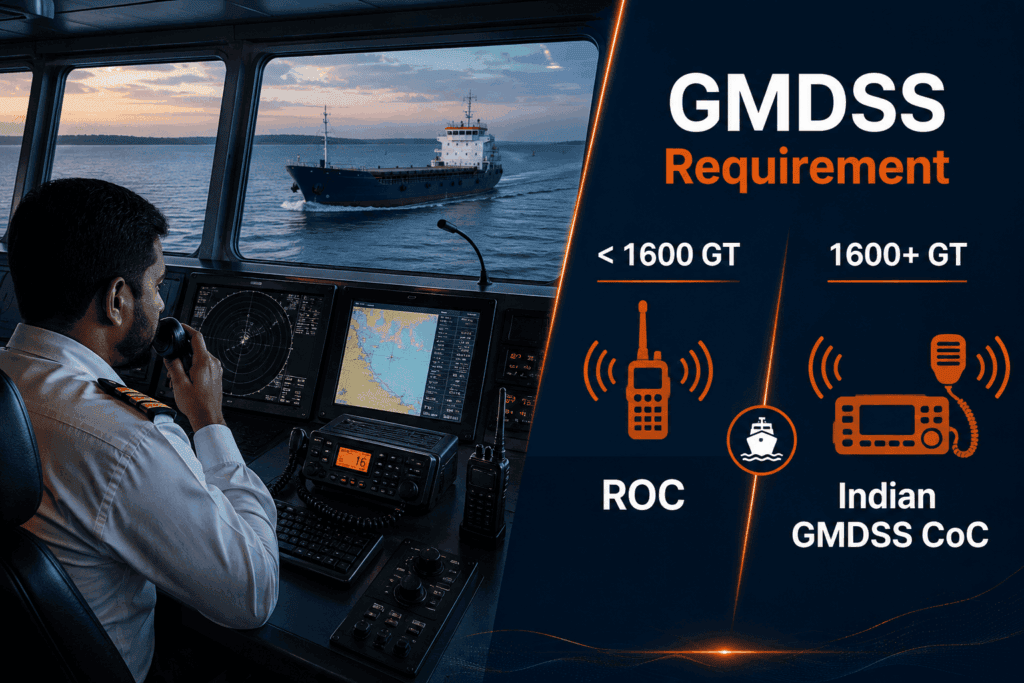
Annexure F-3 uses a 1600 GT threshold for its radio qualification requirement. For vessels below 1600 GT, at least one officer must hold a valid Restricted Operator Certificate. For vessels 1600 GT and above, at least one officer must hold a valid Indian GMDSS Certificate of Competency.
What Are the GT Limits for River-Sea Vessels?
The general notes for F3 to F7 specify different GT limits by RSV vessel type. The limit is 3000 GT for RSV tankers, 6000 GT for RSV cargo vessels and 10,000 GT for RSV dredgers. For RSV tankers, the applicable D.C.E. qualification requirements are specified separately in DG Shipping circulars.
What Extra Manning Applies to RSV Dredgers and Long Voyages?
Dredgers get the same certificate substitution found across the rest of the circular. Master, Mate, and NWKO-NCV certificates can be substituted with Dredge Master Grade I, Dredge Master Grade II, and Dredge Mate Grade I respectively.
RSVs carry a slightly different extra-crew rule than the ICV annexures do, though. For RSVs of 3000 GT and above, one additional 1st Class I/V Master is required when the voyage duration, or dredging operation in port, exceeds 72 hours. That’s a different rank from the “extra NWKO (NCV)” rule used on Annexure F-1 and Annexure F-2, worth double-checking carefully if your fleet runs both ICVs and RSVs, since it’s easy to assume the two 72-hour rules add the same rank when they don’t.
How Is the MSMD Issued for a Type 1 RSV Under Annexure F-3?
The approval process matches every other annexure in the circular, and our pillar guide covers the full MSMD approval workflow in detail. The shipowner or manager submits a manning proposal, with a self-assessment checklist, online to the concerned Mercantile Marine Department.
For a Type 1 RSV specifically, the MMD needs to confirm the vessel actually carries Type 1 classification under DG Shipping Order 18 of 2013 before Annexure F-3 applies at all, rather than assuming any small RSV automatically qualifies. Registered RPSL manning agencies placing crew on RSVs need their own RPSL License in good standing before recruiting for any vessel type covered by this circular. Crew joining should hold current medical clearance from a DGMA approved doctor, per our guide to mandatory medical tests for seafarers, and a current BSID card for the port-side movement most RSV crew changes still involve.
Can a Shipping Company Get a Dispensation From the RSV Type 1 Manning Scale?
Only for genuine exigencies, following the same two-stage process used across the whole circular. Our pillar guide explains the full dispensation process in detail, covering sudden illness, injury, or unavailability of a crew member.
For an RSV under Annexure F-3, the company applies to DGMA’s Nautical Wing with full case details, including the applicable Maritime Union of India wage scale for the rank concerned, then remits the maximum basic wage for that rank once in-principle approval is granted.
Given how small Codes F3-a and F3-b’s crews already are, with 3 and 4 crew, respectively, losing even one crew member can create a significant manning shortfall until a replacement or dispensation is arranged. That makes forward planning around crew availability more critical here than on almost any other annexure in the circular. It’s also worth checking whether the underlying issue qualifies the seafarer for support under one of the SWFS welfare schemes at the same time.
How Does the RSV Type 1 Scale Compare With Every Other Annexure?
Nine annexures into this series, Annexure F-3 sets the floor for minimum crew size across the whole circular.
| Scale | Annexure | Operating Area | Smallest-Code Crew Total | Radio Qualification Threshold |
|---|---|---|---|---|
| Harbour operations | D | Port limits and specified smooth/partially smooth waters | 3 | 500 GT |
| ICV harbour operations | F-1 | Notified port limits | 3 | 500 GT |
| ICV on the Indian coast | F-2 | Indian coast | 4 | Indian GMDSS CoC |
| RSV Type 1 | F-3 | Including harbour operation | 3 | 1600 GT |
Within Annexure F-3, minimum manning ranges from 3 crew below 200 GT to 8 crew for vessels from 3000 GT to below 6000 GT. The operating classification and manning requirements should be read together with the applicable provisions of the RSV framework.
This is a useful pattern to keep in mind as this series moves through the rest of the RSV sub-cluster. Types 2, 3, and 4 each get a progressively wider operating envelope under DG Shipping Order 18 of 2013, and Annexures F-4 through F-7 should track that same widening in their own crew and certificate requirements, the same relationship between operating restriction and manning scale we’ve just traced for Type 1.
What Happens If a Type 1 RSV Sails Below Its Approved Manning Scale?
The baseline rule is unchanged: a vessel must be crewed strictly to the numbers on its approved MSMD. Two points matter specifically for Type 1 RSVs.
First, with crews this small, even Codes F3-a and F3-b, a single missing officer isn’t a minor shortfall, it’s the vessel sailing with half its required bridge team gone. Second, a Type 1 RSV that starts operating beyond its 12 nautical mile, fair-weather-only envelope has moved outside its own vessel classification under DG Shipping Order 18 of 2013. A Type 1 RSV operating outside its approved operating limits would therefore need to be assessed against the applicable vessel classification and regulatory requirements.
FAQs
What is Annexure F-3 of Circular No. 54 of 2025?
Annexure F-3 sets the minimum safe manning requirements for Type 1 River-Sea Vessels, including harbour operation, across Codes F3-a to F3-e.
What is a River-Sea Vessel (RSV)?
An RSV is a vessel built to operate across both inland waterways and coastal waters, classified into four types by operating range and voyage duration under DG Shipping Order No. 18 of 2013.
What makes a vessel RSV Type 1 specifically?
Type 1 RSVs are limited to ship-to-shore operations up to 12 nautical miles beyond inland vessel limits, in fair weather only, the most restricted operating envelope of the four RSV types.
How many crew does a Type 1 RSV under 500 GT need?
F3-a vessels below 200 GT require 3 crew: one Master, one Chief Officer and one OS. F3-b vessels from 200 GT to below 500 GT require 4 crew: one Master, one Chief Officer and two OS.
What GMDSS certificate does a Type 1 RSV need?
Vessels below 1600 GT need at least one officer with a Restricted Operator Certificate. Vessels 1600 GT and above need at least one officer with an Indian GMDSS Certificate of Competency.
Does Annexure F-3 ever require a Foreign-Going certificate?
No. The scale runs entirely on 1st and 2nd Class IV Master certificates and NCV certificates, never rising to a Foreign-Going requirement at any code.
What extra crew is required for RSVs on long voyages?
For RSVs of 3000 GT and above, one additional 1st Class I/V Master is required when the voyage duration or dredging operation in port exceeds 72 hours, a different rank from the extra crew rule used on the ICV annexures.
How does RSV Type 1 differ from ICV harbour operations under Annexure F-1?
Both scales use Class IV qualifications at the smaller tonnage bands, but their manning requirements differ by vessel category and operating area. Annexure F-3 uses a 1600 GT threshold for the ROC/GMDSS requirement.
What are the GT limits for River-Sea Vessels?
The F3-F7 general notes specify limits of 3000 GT for RSV tankers, 6000 GT for RSV cargo vessels and 10,000 GT for RSV dredgers.
Who approves the MSMD for a Type 1 RSV?
The concerned Mercantile Marine Department confirms the vessel genuinely carries Type 1 RSV classification under DG Shipping Order 18 of 2013, then reviews the manning proposal against the correct Annexure F-3 code before issuing the MSMD.