
Minimum safe manning for ICVs on the Indian coast operating on the Indian coast comes from Annexure F-2 of Circular No. 54 of 2025, and it’s a genuinely different scale from the harbour-only rules we covered in our last guide. A vessel under 200 GT needs 4 nautical crew here, not the 3 required under Annexure F-1. A vessel at 3000 GT and above needs a full three-officer bridge team, GMDSS coverage on every vessel regardless of size, and no small-vessel concession anywhere on the scale.
This guide continues our series on minimum safe manning requirements for Indian flag vessels, and it’s the direct companion to Annexure F-1 on ICV harbour operations, the scale for the same vessel classification confined to port limits. We’ve also covered international voyages, near coastal voyages, Indian coast operations under Annexure C, harbour operations under Annexure D, and both Indian and foreign offshore areas elsewhere in this series.
Why Is Annexure F-2 Separate From Annexure F-1?
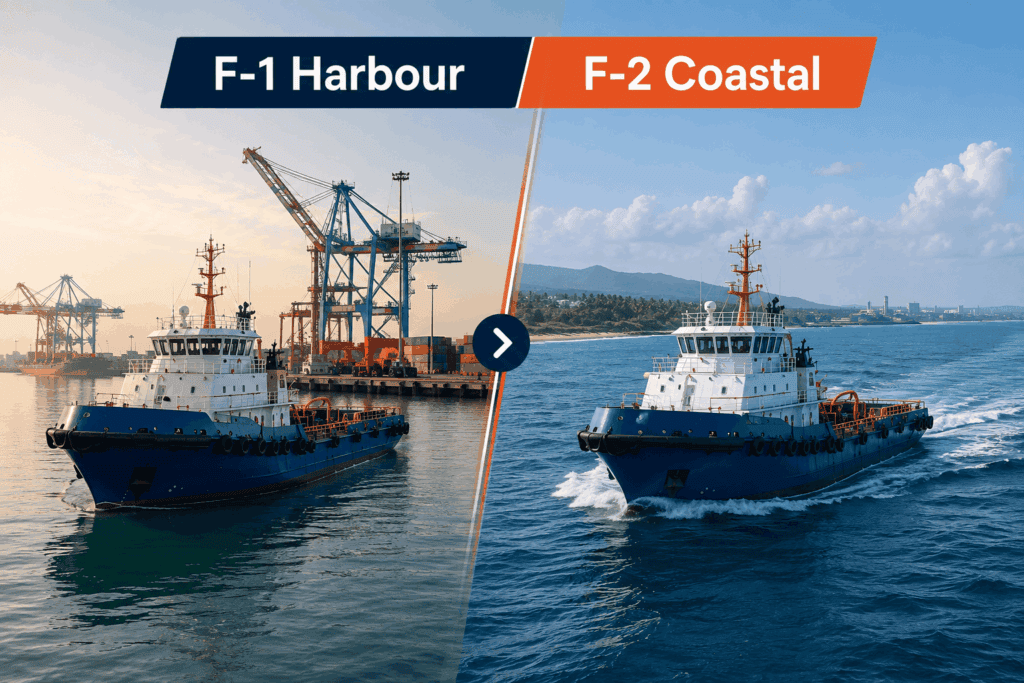
Annexure F covers Indian coastal vessels as a single registration category but splits their manning requirements in two, based entirely on what the vessel is actually doing at the time. Annexure F-1 covers ICVs confined to harbour operation. Annexure F-2 covers the same ICVs once they leave that sheltered, port-limited pattern and trade along the open Indian coast instead.
What Counts as “Operating on the Indian Coast” for an ICV?
The circular’s title for this annexure is direct: Indian Coastal Vessels, when operating on the Indian coast. Unlike F-1, this annexure carries no notified port limits, no six-nautical-mile buffer, and no fair-weather-only framing tied to a harbour boundary. It covers the vessel’s ordinary trading pattern along the coastline itself.
How Does This Differ From Harbour Operation Under Annexure F-1?
The practical difference shows up everywhere in the two tables. Annexure F-1’s smallest code accepts a 1st or 2nd Class IV Master, a harbour-specific certificate tier. Annexure F-2’s smallest code doesn’t use that certificate at all. It’s a genuinely different scale, not the same numbers relabelled, and an ICV operator running both harbour craft and coastal traders needs two separate MSMDs, not one.
The legal basis underneath both scales is identical. IMO Resolution A.1047(27) sets the global minimum safe manning framework, SOLAS Chapter V Regulation 14 makes a manning document mandatory, and the Merchant Shipping Act gives DGMA, the Directorate General of Maritime Administration, the authority to set and enforce both. What differs is purely the operating pattern DGMA is regulating for, and every Indian flag vessel carrying ICV status needs to know which one actually describes its trade.
What Is the Minimum Safe Manning for ICVs on the Indian Coast? (Annexure F-2)
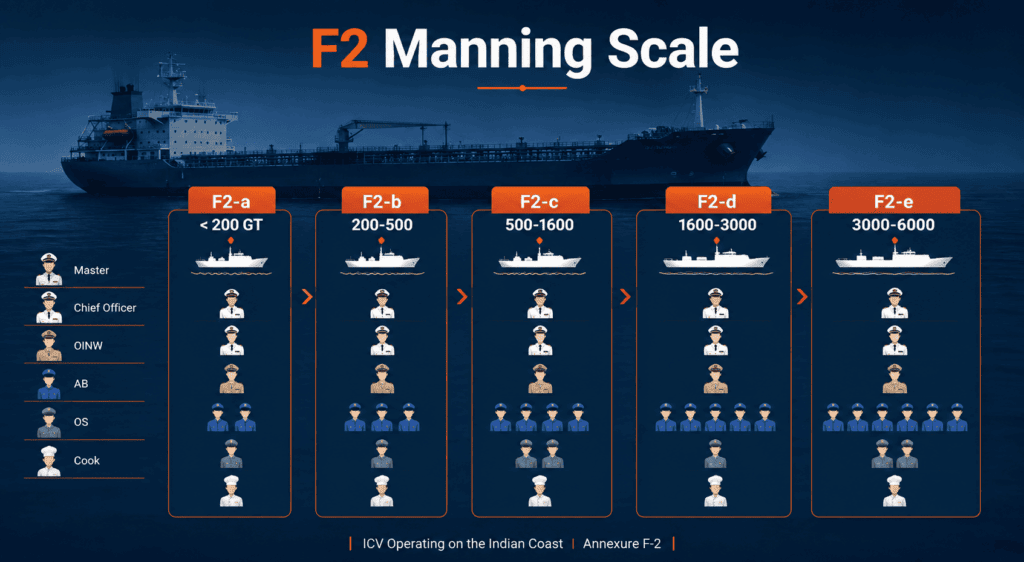
Annexure F-2 covers Indian Coastal Vessels operating along the Indian coast, across five codes, F2-a through F2-e.
| Code | GT of Vessel | Master | Chief Officer | OINW | AB | OS | Cook |
| F2-a | Below 200 | NWKO (NCV), 1 year experience: 1 | 2nd Class IV Master: 1 | Not required | Able Seafarer Deck II/5: 1 | Rating, Basic STCW safety training: 1 | Not required |
| F2-b | 200 to below 500 | Master NCV (500 GT) / Mate NCV, 6 months’ experience: 1 | NWKO (NCV) / 1st Class IV Master: 1 | Not required | Able Seafarer Deck II/5: 1 | Rating, Basic STCW safety training: 1 | Basic STCW safety training + CoC as Cook: 1 |
| F2-c | 500 to below 1600 | Master NCV / Mate NCV, 1 year experience: 1 | NWKO (NCV), 1 year experience: 1 | NWKO NCV / 2nd Class I/V Master: 1 | Able Seafarer Deck II/5: 2 | Rating, Basic STCW safety training: 2 | Basic STCW safety training + CoC as Cook: 1 |
| F2-d | 1600 to below 3000 | Master NCV: 1 | NWKO (NCV), 1 year experience: 1 | NWKO (NCV) / 2nd Class I/V Master: 1 | Able Seafarer Deck II/5: 2 | Rating, Basic STCW safety training: 1 | Basic STCW safety training + CoC as Cook: 1 |
| F2-e | 3000 to below 6000 (GT limits apply, see below) | Master NCV: 1 | Mate (NCV) / NWKO (NCV), 2 years’ experience: 1 | NWKO (NCV), extra crew above 72 hours: 1 | Able Seafarer Deck II/5: 2 | Rating, Basic STCW safety training: 1 | Basic STCW safety training + CoC as Cook: 1 |
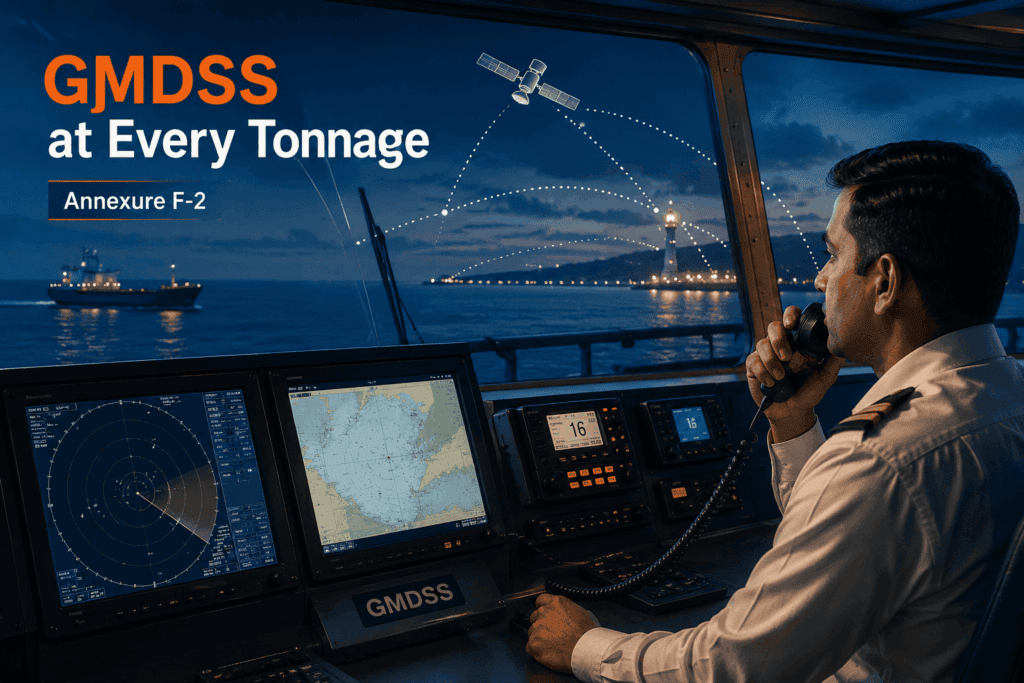
At least one officer on every vessel under this annexure must hold a valid Indian GMDSS Certificate of Competency, at every tonnage, with no exception for smaller vessels. The OINW requirement at Codes F2-c and F2-d does not apply to OSVs, MSVs, PSVs, AHTS, SPS vessels, tugs, or dredgers.
Why Does OS Drop Between Code F2-c and Code F2-d?
This is worth flagging plainly rather than smoothing over. OS sits at 2 on Code F2-c, 500 to below 1600 GT, then drops to 1 on Code F2-d, 1600 to below 3000 GT, before the table moves on to Code F2-e without it rising again. Every other rank on this table holds steady or grows as tonnage increases. We saw a similar non-linear dip on Annexure E-1’s OS requirement, and this looks like the same kind of table quirk rather than a typo. It’s exactly the sort of detail a crewing team should double-check against the current circular before finalising a manning proposal at that specific GT band.
What Changes in Crew Numbers Between Code F2-a and Code F2-e?
The smallest ICVs on the coastal scale, Code F2-a, sail with 4 nautical crew: a Master, a Chief Officer, one AB, and one OS. That’s already one crew member above the 3 required on Annexure F-1’s equivalent code.
Code F2-b adds a cook, bringing the total to 5. The real jump happens at Code F2-c, 500 to below 1600 GT, where a third officer position, OINW, appears for the first time, and AB and OS both double, pushing the total to 8. Codes F2-d and F2-e hold at 7, with the OS dip discussed above accounting for the difference.
How Does F-2 Crew Size Compare With F-1 at the Same Code?
Lining the two tables up side by side tells the real story of why these are separate annexures rather than one scale with a footnote.
| Code Letter | F-1 Crew Total (Harbour) | F-2 Crew Total (Coastal) |
| a | 3 | 4 |
| b | 4 | 5 |
| c | 6 | 8 |
| d | 7 | 7 |
| e | 8 | 7 |
At the smallest and middle tonnage bands, F-2 consistently asks for more crew than F-1 at the identical code letter. By the top of the scale, the gap closes and even reverses slightly, since F-1’s Code F1-e adds a second AB that F-2’s Code F2-e doesn’t carry in the same way. The overall pattern still holds: a vessel doing genuine coastal trade needs more watchkeeping depth than the same vessel confined to a harbour, right up until both scales converge near the top of their tonnage range.
What Certificates Appear on the ICV Coastal Scale?
Annexure F-2 stays on the same NCV and Class IV certificate families as F-1, but arranges them differently at the smallest tier.
Why Does Code F2-a Use an NWKO Certificate for the Master Position?
This is one of the more distinctive details in the whole circular.
The Case for an NWKO at the Smallest Tier
Code F2-a’s Master position is filled by an NWKO (NCV) certificate holder with a year of experience, a Navigational Watchkeeping Officer qualification, rather than a dedicated Master-titled certificate of any kind. Annexure F-1’s smallest code, by contrast, uses a proper 1st or 2nd Class IV Master certificate at the same tonnage. The likely reasoning: a vessel genuinely trading the open coast, even a small one, needs someone with real watchkeeping and pilotage experience at the helm. An NWKO background provides that directly, in a way a harbour-specific command certificate, built for vessels that rarely leave sheltered water, simply doesn’t require.
What This Means for Crew Planning
For a crewing team, this means a Code F2-a vessel and a Code F1-a vessel of identical tonnage need two different hiring profiles for the same “Master” line item. Treating the two certificates as interchangeable because both technically sit at the bottom of their respective scales is the kind of assumption that produces a rejected MSMD application.
When Does a Third Officer Appear on This Scale?
A dedicated OINW position appears from Code F2-c, 500 GT, considerably earlier than the ambiguous entry we found at Annexure F-1’s Code F1-d, 1600 GT. Officers building toward NCV certification can find course options through our directory of DGMA-approved maritime training institutes, ratings build their base qualification through a GP Rating course, and the STCW standards underpinning these certificate tracks are covered in our guide to maritime conventions for Indian seafarers. Officers due for renewal can check the process in our CoC revalidation guide.
Why Does Annexure F-2 Require Full GMDSS Coverage at Every Tonnage?
Annexure F-1 accepts a Restricted Operator Certificate below 500 GT instead of a full Indian GMDSS Certificate of Competency. Annexure F-2 offers no such concession. Every vessel, at every tonnage, needs at least one officer holding the full GMDSS CoC.
The reasoning matches what we found on Annexure E-1: a vessel confined to a harbour can usually get help quickly if something goes wrong, while a vessel genuinely trading the open coast, even close to shore, faces a communication and rescue-coordination burden that a Restricted Operator Certificate isn’t built to cover. It’s a small rule with an outsized practical effect on a small ICV operator, since it means every coastal ICV, regardless of size, needs at least one properly GMDSS-qualified officer on the crew list, a cost that harbour-only operators under F-1 don’t necessarily carry.
What Are the GT Limits for Different Types of ICVs on This Scale?
The same type-based ceilings that apply throughout Annexure F carry over here. ICV tankers are capped at 3000 MT, ICV cargo vessels at 6000 MT, and ICV dredgers at 10,000 MT, the same limits we covered on Annexure F-1.
Tanker operations under Annexure F-2 also carry a Dangerous Cargo Endorsement requirement, referred to in the circular’s own notes as D.C.E., with the specific standard set out separately in relevant circulars issued under the Merchant Shipping Act, on top of whatever base crew Annexure F-2 specifies for that tanker’s code.
What Extra Manning Applies to ICV Dredgers Under Annexure F-2?
Dredgers get the same two concessions found across the rest of the circular. Master, Mate, and NWKO-NCV certificates can be substituted with Dredge Master Grade I, Dredge Master Grade II, and Dredge Mate Grade I respectively. For vessels 3000 GT and above, one additional NWKO (NCV) is required whenever the voyage duration or dredging and port operation exceeds 72 hours, on top of the base crew shown for Code F2-e.
How Is the MSMD Issued for an ICV Under Annexure F-2?
The approval process is unchanged from the rest of the circular, and our pillar guide covers the full MSMD approval workflow in detail. The shipowner or manager submits a manning proposal, with a self-assessment checklist, online to the concerned Mercantile Marine Department.
For an ICV trading the coast specifically, the MMD checks that the vessel’s actual operating pattern genuinely fits Annexure F-2 rather than the harbour-confined pattern covered under F-1, since the two carry different crew requirements at nearly every code. Registered RPSL manning agencies placing crew on ICV coastal vessels should confirm certificates against the correct F-2 code, and agencies handling this kind of placement work need their own MLC 2006 certification under Regulation 1.4, separate from the vessel’s own MSMD. Crew joining should also hold current medical clearance from a DGMA approved doctor, per our guide to mandatory medical tests for seafarers, along with a current BSID card for port-side movement.
Can a Shipping Company Get a Dispensation From the ICV Coastal Manning Scale?
Only for genuine exigencies, following the same two-stage process used across the whole circular. Our pillar guide explains the full dispensation process in detail, covering sudden illness, injury, or unavailability of a crew member.
For an ICV under Annexure F-2, the company applies to DGMA’s Nautical Wing with full case details, including the applicable Maritime Union of India wage scale for the rank concerned, then remits the maximum basic wage for that rank once in-principle approval is granted. Since coastal ICVs spend more time away from a home port than their harbour counterparts under F-1, arranging a same-day replacement is often harder, and it’s worth checking whether the underlying issue also qualifies the seafarer for support under one of the SWFS welfare schemes at the same time.
How Does the ICV Coastal Scale Compare With Every Other Annexure?
Eight annexures into this series, Annexure F-2 lands closest to Annexure C in spirit, even though the two apply to different vessel classifications.
| Scale | Annexure | Operating Area | Entry Master Qualification | GT Bands | GMDSS Rule |
| Indian coast, incl. A&N and Lakshadweep | C | Coastline and island territories | Master NCV or Mate NCV | 6 | 1 officer (ROC below 200 GT) |
| Harbour operations | D | Port limits, fair weather | Class IV Master | 7 | 1 officer (ROC below 500 GT) |
| ICV harbour operations | F-1 | Notified port limits, ICV only | Class IV Master | 5 | 1 officer (ROC below 500 GT) |
| ICV on the Indian coast | F-2 | Indian coast trade, ICV only | NWKO (NCV) | 5 | 1 officer, no exception |
Annexure C and Annexure F-2 both cover vessels genuinely trading the Indian coast, but Annexure C applies to any qualifying vessel, while Annexure F-2 applies only to ICVs with their type-based GT ceilings layered on top. The GMDSS pattern is the more telling comparison. Every scale confined to a harbour or a smaller vessel band offers some concession, a Restricted Operator Certificate or a reduced officer requirement. Both genuinely open-coast scales, Annexure C above 200 GT and all of Annexure F-2, hold the line at full GMDSS coverage instead.
That pattern has held across every annexure in this series so far. It’s worth stating plainly as the closest thing the circular has to a single unifying rule: the further a vessel’s actual work takes it from a sheltered harbour, the less DGMA is willing to accept a lighter communication or certificate standard, regardless of how small the vessel itself happens to be.
What Happens If an ICV Sails Below Its Approved Manning Scale on the Coast?
The baseline rule doesn’t change: an ICV must be crewed strictly to the numbers on its approved MSMD. What’s worth restating for Annexure F-2 specifically is the risk of using an F-1 approval for what is actually coastal trade.
An ICV approved under Annexure F-1’s harbour scale that starts making regular coastal runs is no longer operating within the basis its MSMD was issued on, even if its current crew technically meets F-1’s lighter numbers. The GMDSS gap is the one inspectors are most likely to catch first, since an ICV relying on F-1’s Restricted Operator Certificate concession while actually trading the open coast under F-2’s rules is missing exactly the equipment and qualification the coastal scale exists to require.
FAQs
What is Annexure F-2 of Circular No. 54 of 2025?
Annexure F-2 sets minimum safe manning for Indian Coastal Vessels, ICVs, operating along the Indian coast, as opposed to confined harbour operation, across Codes F2-a to F2-e.
What is the difference between Annexure F-1 and Annexure F-2?
Both cover ICVs, but F-1 applies to vessels confined to harbour operation and accepts Class IV Master certificates at the smallest tonnage. F-2 applies to vessels genuinely trading the Indian coast, uses an NWKO certificate at its smallest code instead, and requires full GMDSS coverage at every tonnage with no small-vessel concession.
How many crew does an ICV under 200 GT need under Code F2-a?
Code F2-a requires an NWKO (NCV) with a year of experience filling the Master position, a 2nd Class IV Master as Chief Officer, one AB, and one OS, a total of 4 nautical crew.
Why does Code F2-a use an NWKO certificate instead of a Master certificate?
The circular doesn’t state a reason explicitly, but a vessel trading the open coast, even a small one, needs genuine watchkeeping and pilotage experience, which an NWKO background provides more directly than a harbour-specific Master certificate.
Does Annexure F-2 allow a Restricted Operator Certificate for small vessels?
No. Every vessel under this annexure, regardless of tonnage, needs at least one officer holding a full Indian GMDSS Certificate of Competency, unlike Annexure F-1, which accepts a Restricted Operator Certificate below 500 GT.
When does a third officer appear on the ICV coastal scale?
A dedicated OINW position appears from Code F2-c, 500 GT, earlier than the equivalent point on Annexure F-1.
What are the GT limits for ICVs under Annexure F-2?
The same type-based ceilings used across Annexure F: 3000 MT for tankers, 6000 MT for cargo vessels, and 10,000 MT for dredgers.
Do ICV dredgers get manning concessions under Annexure F-2?
Yes. Dredgers can substitute Master, Mate, and NWKO-NCV certificates with Dredge Master and Dredge Mate grades, and need one additional NWKO (NCV) for operations exceeding 72 hours, from 3000 GT and above.
Can an ICV use its Annexure F-1 MSMD while trading the coast?
No. An ICV that regularly trades the open coast needs an MSMD approved under Annexure F-2, since the crew numbers, GMDSS requirement, and certificate structure differ from the harbour-only scale under F-1.
Who approves the MSMD for an ICV under Annexure F-2?
The concerned Mercantile Marine Department reviews the shipowner’s proposal against the correct Annexure F-2 code and confirms the vessel’s actual operating pattern matches coastal trade rather than harbour-confined operation before issuing the MSMD.
What is Annexure F-2 of Circular No. 54 of 2025?
Annexure F-2 sets minimum safe manning for Indian Coastal Vessels, ICVs, operating along the Indian coast, as opposed to confined harbour operation, across Codes F2-a to F2-e.
What is the difference between Annexure F-1 and Annexure F-2?
Both cover ICVs, but F-1 applies to vessels confined to harbour operation and accepts Class IV Master certificates at the smallest tonnage. F-2 applies to vessels genuinely trading the Indian coast, uses an NWKO certificate at its smallest code instead, and requires full GMDSS coverage at every tonnage with no small-vessel concession.
How many crew does an ICV under 200 GT need under Code F2-a?
Code F2-a requires an NWKO (NCV) with a year of experience filling the Master position, a 2nd Class IV Master as Chief Officer, one AB, and one OS, a total of 4 nautical crew.
Why does Code F2-a use an NWKO certificate instead of a Master certificate?
The circular doesn’t state a reason explicitly, but a vessel trading the open coast, even a small one, needs genuine watchkeeping and pilotage experience, which an NWKO background provides more directly than a harbour-specific Master certificate.
Does Annexure F-2 allow a Restricted Operator Certificate for small vessels?
No. Every vessel under this annexure, regardless of tonnage, needs at least one officer holding a full Indian GMDSS Certificate of Competency, unlike Annexure F-1, which accepts a Restricted Operator Certificate below 500 GT.
When does a third officer appear on the ICV coastal scale?
A dedicated OINW position appears from Code F2-c, 500 GT, earlier than the equivalent point on Annexure F-1.
What are the GT limits for ICVs under Annexure F-2?
The same type-based ceilings used across Annexure F: 3000 MT for tankers, 6000 MT for cargo vessels, and 10,000 MT for dredgers.
Do ICV dredgers get manning concessions under Annexure F-2?
Yes. Dredgers can substitute Master, Mate, and NWKO-NCV certificates with Dredge Master and Dredge Mate grades, and need one additional NWKO (NCV) for operations exceeding 72 hours, from 3000 GT and above.
Can an ICV use its Annexure F-1 MSMD while trading the coast?
No. An ICV that regularly trades the open coast needs an MSMD approved under Annexure F-2, since the crew numbers, GMDSS requirement, and certificate structure differ from the harbour-only scale under F-1.
Who approves the MSMD for an ICV under Annexure F-2?
The concerned Mercantile Marine Department reviews the shipowner’s proposal against the correct Annexure F-2 code and confirms the vessel’s actual operating pattern matches coastal trade rather than harbour-confined operation before issuing the MSMD.