
Minimum safe manning for Indian coastal vessels in harbour operations comes from Annexure F-1 of Circular No. 54 of 2025, and it sets one of the lightest crew scales in the entire circular. A vessel under 200 GT needs just 3 nautical crew. A vessel at 6000 GT still needs only 8, far fewer than an ICV of the same size trading the open Indian coast instead of staying inside a harbour.
Annexure F covers Indian Coastal Vessels, commonly shortened to ICVs, a distinct registration category with its own tonnage ceilings, and Annexure F-1 specifically is the scale for ICVs confined to harbour operation. This guide continues our series on minimum safe manning requirements for Indian flag vessels, and it sits closest in structure to the guides we’ve already published on harbour operations under Annexure D and Indian coast operations under Annexure C. We’ve also covered international voyages, near coastal voyages, Indian offshore areas, and foreign offshore areas elsewhere in this series.
Why Does Annexure F Give Indian Coastal Vessels Their Own Harbour Scale?
Annexure F sits apart from Annexures A through E-2 because it isn’t organised around a single voyage type or operating area. It’s organised around a vessel classification, the Indian Coastal Vessel, and then subdivided by what that vessel is actually doing, harbour operation under F-1 and F-2, and river-sea work under a separate set of codes, F-3 through F-7.
The legal chain behind Annexure F is the same one behind every other scale in the circular. IMO Resolution A.1047(27) sets the global minimum safe manning framework, SOLAS Chapter V Regulation 14 makes a manning document mandatory, and the Merchant Shipping Act gives DGMA, the Directorate General of Maritime Administration, the authority to set and enforce it. What changes here is the underlying vessel classification: every rule downstream in Annexure F assumes the vessel in question is registered specifically as an Indian flag vessel carrying ICV status, not just any coastal trader.
What Is an Indian Coastal Vessel (ICV)?
An ICV is a vessel category defined by tonnage ceilings tied to vessel type rather than a single blanket limit. Tankers registered as ICVs are capped at 3000 MT, cargo vessels at 6000 MT, and dredgers at 10,000 MT. That’s a different structure from every annexure we’ve covered so far, where GT bands apply the same way regardless of what the vessel actually carries. Before any of this applies, though, the vessel has to be Indian-flagged in the first place. Owners bringing a foreign-owned vessel into the ICV fleet need to complete that flag registration process before Annexure F, or any other part of the circular, applies to it at all.
How Is Harbour Operation Defined for ICVs?
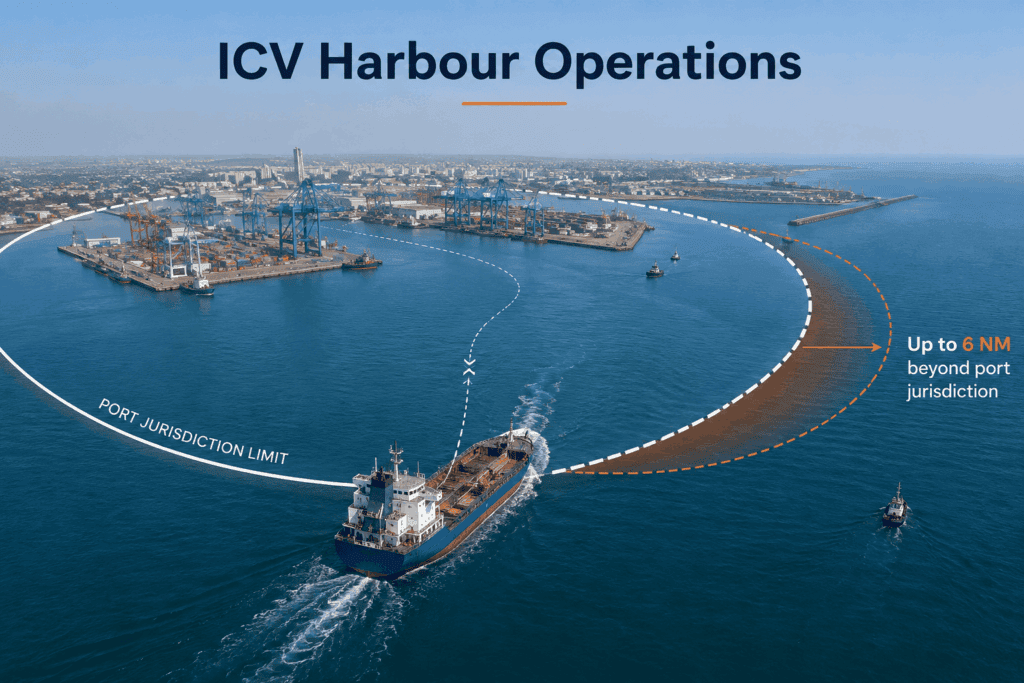
The circular’s Note 1 for this annexure defines harbour operations as work within notified port limits, with occasional operations permitted up to six nautical miles beyond port jurisdiction.
How This Differs From the Harbour Definition on Annexure D
Annexure D’s harbour definition covers operations within notified port limits, and operations in smooth or partially smooth waters near a port, in fair weather. It doesn’t specify a distance buffer beyond the port itself. Annexure F-1’s definition does, explicitly allowing occasional trips up to six nautical miles past port jurisdiction. That’s a small but genuinely useful difference for an ICV operator running short bunkering, ship-to-ship, or supply runs just outside a harbour’s formal boundary. Those trips still count as harbour operation under F-1’s wording, even though a strict reading of Annexure D’s definition might not cover the same distance as clearly.
What Is the Minimum Safe Manning Scale for ICV Harbour Operations? (Annexure F-1)
Annexure F-1 covers Indian Coastal Vessels engaged in harbour operation, across five codes, F1-a through F1-e.
| Code | GT of Vessel | Master | Chief Officer | OINW | AB | OS | Cook |
| F1-a | Below 200 | 1st Class IV Master / 2nd Class IV Master, 1 year experience: 1 | 2nd Class IV Master: 1 | Not required | Not required | Rating, Basic STCW safety training: 1 | Not required |
| F1-b | 200 to below 500 | 1st Class IV Master: 1 | 2nd Class IV Master: 1 | Not required | Not required | Rating, Basic STCW safety training: 1 | Basic STCW safety training + CoC as Cook: 1 |
| F1-c | 500 to below 1600 | Mate NCV / NWKO (NCV), 1 year experience: 1 | NWKO (NCV) / 1st Class IV Master / 2nd Class IV Master, 1 year experience: 1 | Not required | Able Seafarer Deck II/5: 1 | Rating, Basic STCW safety training: 2 | Basic STCW safety training + CoC as Cook: 1 |
| F1-d | 1600 to below 3000 | Master NCV / Mate NCV, 1 year experience: 1 | NWKO (NCV) / 1st Class IV Master, 1 year experience: 1 | See note below: 1 | Able Seafarer Deck II/5: 1 | Rating, Basic STCW safety training: 2 | Basic STCW safety training + CoC as Cook: 1 |
| F1-e | 3000 to below 6000 (GT limits apply, see below) | Master NCV: 1 | Mate (NCV) / NWKO (NCV), 1 year experience: 1 | NWKO (NCV), extra crew above 72 hours: 1 | Able Seafarer Deck II/5: 2 | Rating, Basic STCW safety training: 2 | Basic STCW safety training + CoC as Cook: 1 |
At least one officer on vessels 500 GT and above must hold a valid Indian GMDSS Certificate of Competency. Below 500 GT, a Restricted Operator Certificate satisfies the requirement instead. Tanker operations follow a separate D.C.E. qualification standard set out in DGMA’s circulars for Merchant Shipping Act vessels, on top of the base crew shown here.
What Does the Unusual OINW Entry at Code F1-d Mean?
Every other annexure we’ve reviewed in this series follows one consistent rule: when a rank’s qualification column shows a dash, meaning no certificate is specified, its headcount also shows a dash, meaning the position isn’t required at all. Code F1-d breaks that pattern. Its OINW qualification field is blank, but the headcount still shows 1.
The most plausible reading is that F1-d asks for one additional body available for watchkeeping duty without yet mandating a distinct, separately named certificate for that role, a middle step between F1-c, which has no OINW position at all, and F1-e, which fully establishes a dedicated NWKO (NCV) requirement. That’s a reasonable interpretation, not a confirmed one, and it’s the kind of detail worth a direct question to DGMA or a surveyor if your fleet runs a vessel at exactly this GT band.
What Changes in Crew Numbers Between Code F1-a and Code F1-e?
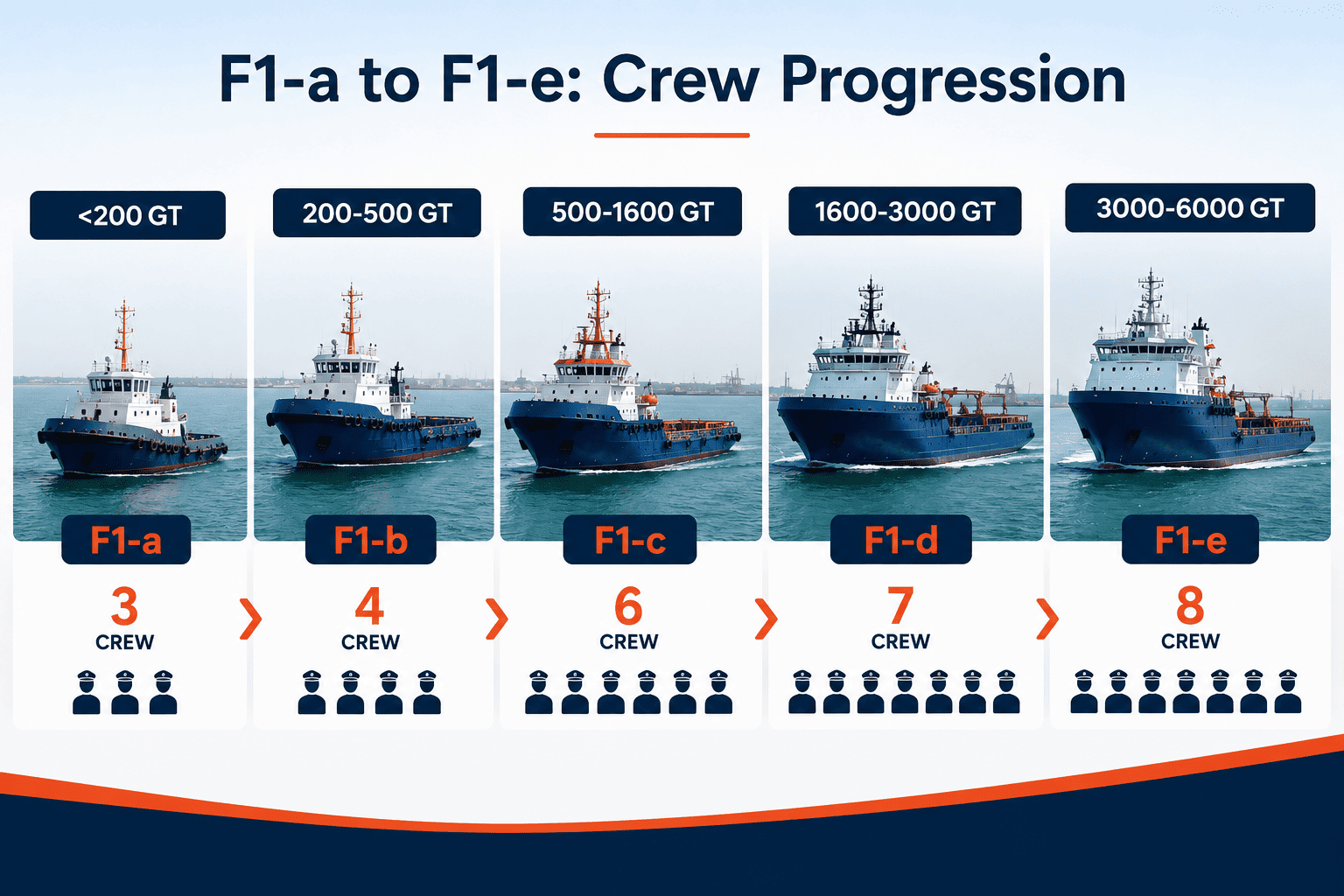
The smallest ICVs in harbour operation, Code F1-a, sail with just 3 nautical crew, a Master, a Chief Officer, and one OS, the same lean structure we found on Annexure D’s smallest code. By Code F1-b, 200 to 500 GT, a cook joins the crew, bringing the total to 4.
Code F1-c adds a dedicated AB and a second OS, taking the total to 6, and introduces experience-based qualifications, a Mate NCV or NWKO with a year of sea time, rather than a fresh certificate alone. Code F1-d holds crew size at 7, with the OINW entry discussed above accounting for the increase from F1-c. By Code F1-e, 3000 to 6000 GT, the total reaches 8, with a second AB joining the crew and the OINW position now carrying an explicit NWKO (NCV) certificate requirement.
What Certificates Appear on the ICV Harbour Scale?
Annexure F-1 leans on the same lower-tier certificate structure we first saw on Annexure D, reflecting how both scales cover vessels confined to sheltered, close-to-port work.
Where Do Class IV Certificates Fit In?
Codes F1-a and F1-b accept 1st Class IV Master and 2nd Class IV Master certificates, the same harbour-specific certification tier Annexure D uses at its own smallest codes. This lets an operator crew a small ICV harbour craft without an NCV or Foreign-Going certificate anywhere on board.
When Do NCV Certificates Take Over?
From Code F1-c onward, NCV certificates become the standard, a Mate NCV or NWKO (NCV), often with a year of documented experience, filling the top officer positions. Unlike Annexure D, which eventually requires Foreign-Going certificates at its highest tonnage bands, Annexure F-1 never asks for an FG certificate anywhere on its five codes. Officers building toward an NCV certificate typically train through courses listed in our directory of DGMA-approved maritime training institutes, ratings build their base qualification through a GP Rating course, and officers due for renewal can check the process in our CoC revalidation guide. The STCW watchkeeping standards behind these certificate tracks are covered in our guide to maritime conventions for Indian seafarers.
Crew joining an ICV harbour vessel move in and out of the port area often enough that a current BSID card is worth confirming before sign-on, alongside the medical clearance covered later in this guide.
What Are the GT Limits for Different Types of ICVs?
This is the detail that makes the ICV category structurally different from every other annexure in the circular. Rather than one GT scale applying to all vessel types, Annexure F sets separate ceilings by what the vessel actually does.
Why Do Tankers, Cargo Vessels, and Dredgers Have Different Ceilings?
ICV tankers are capped at 3000 MT, ICV cargo vessels at 6000 MT, and ICV dredgers at 10,000 MT. The logic tracks risk and cargo type rather than raw size. A tanker carrying liquid cargo faces a lower ceiling before it’s pushed into a different manning framework entirely, while a dredger, whose work is inherently tied to harbour and channel maintenance, gets the widest allowance.
Tanker operations under this annexure also carry a certificate requirement most other ranks on this table don’t: a valid Dangerous Cargo Endorsement, abbreviated D.C.E. in the circular’s own notes. This sits on top of whatever Master, Chief Officer, and rating headcount Annexure F-1 specifies for that tanker’s code, and the exact standard for it is set out separately in DGMA’s own circulars for vessels registered under the Merchant Shipping Act, rather than inside Annexure F-1 itself.
What Is the Special Rule for ICVs Working at an SPM Facility?
Annexure F-1 carries the exact same Single Point Mooring rule we explained in detail on Annexure D. Vessels under 500 GT engaged in continuous service at an SPM facility within notified port limits must carry at least one officer holding a valid STCW certificate of competency, on top of the base crew for that vessel’s code.
Given how many ICVs support tanker discharge and liquid cargo transfer operations, this rule matters more here than its single line in the notes might suggest. An ICV support craft working an SPM facility needs to check this requirement alongside its base F1 code, not instead of it.
What Extra Manning Applies to ICV Dredgers?
Dredgers under Annexure F-1 get the same two concessions found across the rest of the circular. Master, Mate, and NWKO-NCV certificates can be substituted with Dredge Master Grade I, Dredge Master Grade II, and Dredge Mate Grade I respectively. And for vessels 3000 GT and above, one additional NWKO (NCV) is required whenever the voyage duration or dredging and port operation exceeds 72 hours, on top of the base crew shown for Code F1-e.
Dredging work is a natural fit for the ICV harbour category specifically, since channel and berth maintenance happens almost entirely within the same notified port limits that define harbour operation in the first place.
How Is the MSMD Issued for an ICV Under Annexure F-1?
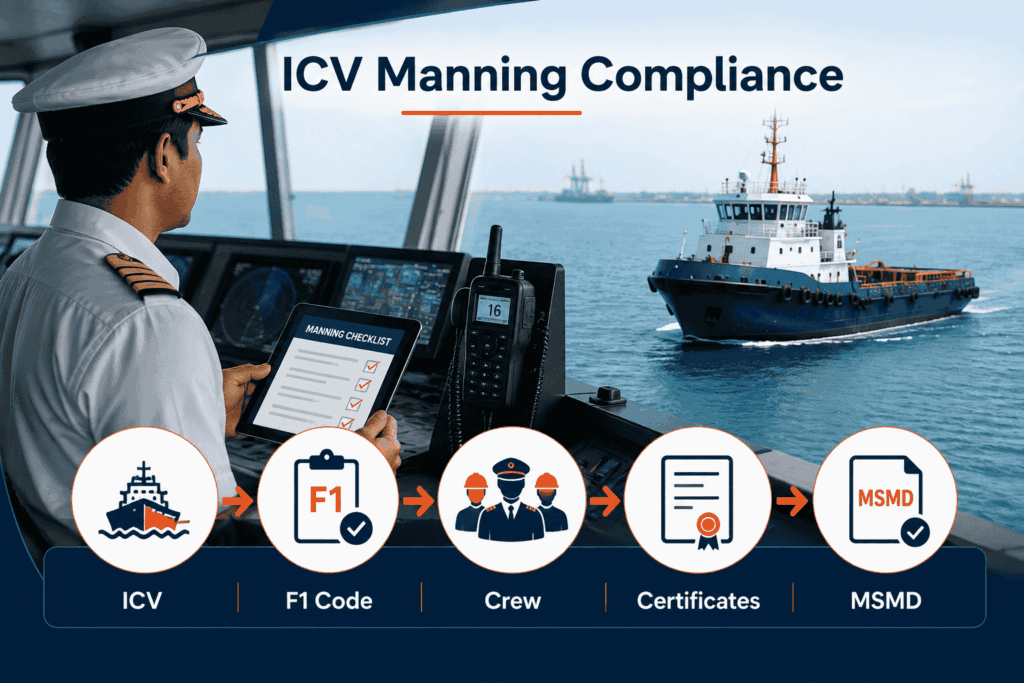
The core approval process matches every other annexure in the circular, and our pillar guide covers the full MSMD approval workflow in detail. The shipowner or manager submits a manning proposal, with a self-assessment checklist, online to the concerned Mercantile Marine Department.
For an ICV specifically, the MMD checks two things closely: that the vessel’s GT sits within the correct ceiling for its type, tanker, cargo, or dredger, and that its actual operating pattern genuinely fits the harbour operation definition rather than the general Indian coast trade covered separately under Annexure F-2. Registered RPSL manning agencies crewing ICV harbour vessels should confirm certificates against the correct code before mobilisation, and crew should hold current medical clearance from a DGMA approved doctor, per our guide to mandatory medical tests for seafarers.
Can a Shipping Company Get a Dispensation From the ICV Harbour Manning Scale?
Only for genuine exigencies, following the same two-stage process used across the whole circular. Our pillar guide explains the full dispensation process in detail, covering sudden illness, injury, or unavailability of a crew member.
For an ICV under Annexure F-1, the company applies to DGMA’s Nautical Wing with full case details, including the applicable Maritime Union of India wage scale for the rank concerned, then remits the maximum basic wage for that rank once in-principle approval is granted. Since ICV harbour vessels rarely leave port for long, replacement crew are usually easier to arrange quickly than on a sea-going trade, and it’s worth checking whether the underlying issue also qualifies the affected seafarer for support under one of the SWFS welfare schemes alongside the dispensation request.
How Does the ICV Harbour Scale Compare With Other Annexures?
Seven annexures into this series, Annexure F-1 slots in right alongside Annexure D at the lightest end of the whole circular.
| Scale | Annexure | Operating Area | Entry Master Qualification | GT Bands | Smallest-Code Crew Total |
| International voyages | A | Worldwide trade | Master (FG) | 4 | 6 |
| Near coastal voyages | B | Defined near-coastal zone | Master NCV or Mate NCV | 5 | 5 |
| Indian coast, incl. A&N and Lakshadweep | C | Coastline and island territories | Master NCV or Mate NCV | 6 | 4 |
| Harbour operations | D | Port limits, fair weather | Class IV Master | 7 | 3 |
| Indian offshore areas | E-1 | 20 NM to Indian EEZ | Master NCV or Mate NCV | 6 | 5 |
| Foreign offshore areas | E-2 | Outside NCV area, foreign waters | Master (FG) | 5 | 5 |
| ICV harbour operations | F-1 | Notified port limits, ICV only | Class IV Master | 5 | 3 |
Annexure F-1 and Annexure D share the same certificate floor and the same smallest-code crew size, 3 nautical crew, but they aren’t interchangeable. Annexure D applies to any self-propelled vessel in harbour operation. Annexure F-1 applies only to vessels that carry ICV registration specifically, with its own GT ceilings by vessel type layered on top. A vessel can be small enough and confined enough to look like an Annexure D case while actually needing Annexure F-1 instead, purely because of how it’s registered.
What Happens If an ICV Sails Below Its Approved Manning Scale?
The rule is unchanged from the rest of the circular: an ICV must be crewed strictly to the numbers on its approved MSMD. Two things make this worth restating specifically for Annexure F-1.
First, the six-nautical-mile buffer in the harbour operation definition is easy to over-read as a general licence to work further offshore than intended, when it only covers occasional trips beyond notified port limits, not routine operation there. Second, an ICV that has grown past its type-specific GT ceiling, a tanker approaching 3000 MT or a cargo vessel approaching 6000 MT, needs a fresh look at whether it still qualifies as an ICV at all, or whether it has effectively moved into a different annexure’s territory. Inspectors reviewing ICV harbour vessels check both points alongside the standard headcount and certificate review.
Annexure F-1 only covers half of the ICV picture. An Indian Coastal Vessel that trades beyond harbour limits, along the general Indian coast, moves to Annexure F-2 instead, with its own crew requirements for that wider operating pattern. We’ll cover that scale in the next guide in this series.
FAQs
What is Annexure F-1 of Circular No. 54 of 2025?
Annexure F-1 sets minimum safe manning for Indian Coastal Vessels, ICVs, engaged in harbour operation, meaning work within notified port limits with occasional trips permitted up to six nautical miles beyond port jurisdiction, across Codes F1-a to F1-e.
How many crew does an ICV under 200 GT need under Code F1-a?
Code F1-a requires a 1st or 2nd Class IV Master, a 2nd Class IV Master as Chief Officer, and one OS rating, a total of 3 nautical crew.
What is an Indian Coastal Vessel (ICV)?
An ICV is a vessel classification under the circular with tonnage ceilings set by vessel type: 3000 MT for tankers, 6000 MT for cargo vessels, and 10,000 MT for dredgers, rather than one blanket GT limit.
What certificate does the Master need under Annexure F-1?
Certificates range from 1st or 2nd Class IV Master on the smallest vessels, to Mate NCV or NWKO (NCV) from roughly 500 GT, to Master NCV from 3000 GT. No code on this scale requires a Foreign-Going certificate.
How is harbour operation defined for an ICV?
Operation within notified port limits, with occasional trips permitted up to six nautical miles beyond port jurisdiction, a slightly wider buffer than the harbour definition used on Annexure D.
What GMDSS certificate does an Annexure F-1 vessel need?
Vessels 500 GT and above need at least one officer with a valid Indian GMDSS Certificate of Competency. Below 500 GT, at least one officer with a Restricted Operator Certificate satisfies the requirement.
What is the special rule for ICVs working at an SPM facility?
Vessels under 500 GT in continuous service at a Single Point Mooring facility within notified port limits must carry at least one officer holding a valid STCW certificate of competency, the same rule that applies on Annexure D.
Do ICV dredgers get any manning concessions?
Yes. Dredgers can substitute Master, Mate, and NWKO-NCV certificates with Dredge Master and Dredge Mate grades, and need one additional NWKO (NCV) for operations exceeding 72 hours, from 3000 GT and above.
How does Annexure F-1 differ from Annexure D?
Both cover harbour operation with similar certificate levels, but Annexure F-1 applies only to Indian Coastal Vessels specifically, with GT ceilings set by vessel type, while Annexure D applies to any self-propelled vessel in harbour operation.
Who approves the MSMD for an ICV under Annexure F-1?
The concerned Mercantile Marine Department reviews the shipowner’s proposal against the correct Annexure F-1 code and confirms the vessel’s GT sits within its type-specific ceiling before issuing the MSMD.